
UI/UX designer resume example
A practical Indian UI/UX designer resume format, with sample statements for freshers and experienced applicants.
The button opens the existing template and role-starter flow. Where no matching starter exists, start blank and copy suitable statements below.
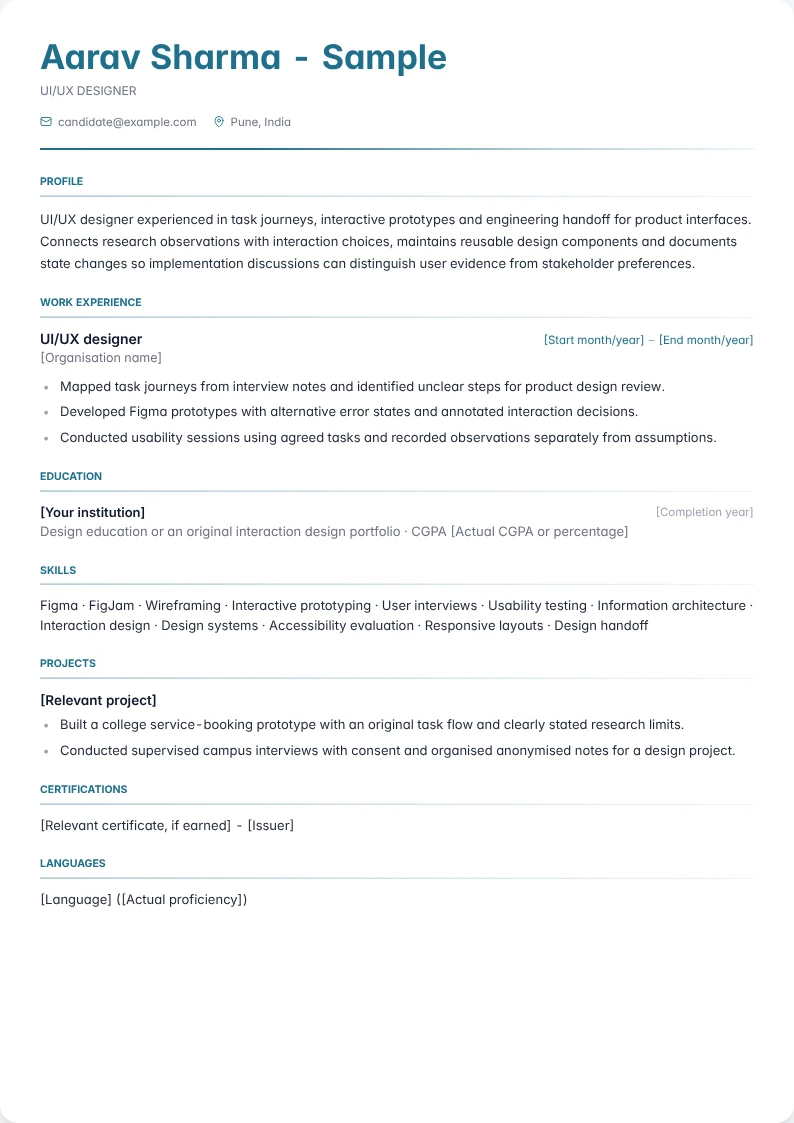
Sample resume, not a real candidate
Aarav Sharma is fictional. Institution, organisation, grades and date fields are placeholders. Replace them with your real details. This is the Modern Clean layout.
Choose an interface, interaction or research opening
UI designer, UX designer, UI/UX designer and junior product designer listings in India can emphasise different deliverables. Read whether the vacancy prioritises visual systems, interaction flows, research or engineering handoff. Put a portfolio link and the relevant case study near the summary. Recruiters may inspect the problem, your contribution and the reasoning before looking at screen polish. For interface production, lead with reusable components and responsive states; for research, lead with a question, session method and findings. A design graduate can select an original college service concept. Experienced applicants can begin with work taken through implementation discussions, giving the hiring team an immediate view of the design function they performed.
Build a case study around a user task
Choose a booking, registration or timetable journey with an understandable goal. Start with the task and constraints, then show the flow, wireframes and prototype. Explain a design choice through the evidence or assumption available at that point. Include a discarded alternative and why the selected interaction suited the task. For a group assignment, name the research guide, screen set or component you created. Put an observed usability issue beside the revised interaction so the reader can follow the change. A fresher concept can demonstrate reasoning even before implementation. Experienced designers can show how engineering feedback altered a state or layout and what was checked in the delivered interface.
Prepare research and design exercise explanations
A portfolio conversation may ask how you framed a session, wrote task prompts or interpreted an observation. Practise describing what a participant did, the difficulty identified and the design response considered. Keep assumptions visible in a concept that has not been evaluated. A practical design exercise may involve information architecture, error messages or an unfamiliar form. Explain label choices, grouping and recovery states as part of the task flow. Use Figma variants to show loading, empty and failed states alongside ordinary screens. When discussing accessibility, name persistent labels, contrast checks and focus annotations, then distinguish those design specifications from checks made on a working interface with assistive technology.
Make education and the portfolio easy to locate
Keep a visible portfolio URL beside the design qualification, college and passing or anticipated graduation date. Where a campus notice requests marks, enter the institution's official percentage or CGPA together with the grading scale, using its authorised formula for conversion. Typography modules can explain hierarchy in the registration screens; research-methods assignments can support the usability session guide. An interaction-design capstone deserves a descriptive title and a direct link to its flow and prototype. A placement row can identify the variants, annotations or research synthesis created. Career changers can retain useful domain knowledge below the strongest case study. Check that the hiring team can reach the rationale without requesting access to a private deck.
Use design credentials to support case study work
The Google UX Design Certificate is offered as the Google UX Design Professional Certificate through Coursera. Record the exact earned title and provider. NN/g UX Certification, also described as Nielsen Norman Group UX Certification, is another verifiable programme; check its current completion requirements with the issuer. Choose learning that strengthens a project question, research method or interaction decision. A course case study can show the task, alternatives and prototype you produced, with its educational setting identified. Indian design employers may place portfolio exercises ahead of certificate lists, so keep the practical reasoning accessible. Credentials support learning rather than establish a statutory design licence, and completed study belongs alongside evidence of how the methods were used.
Share a clear and respectful design presentation
State your contribution and project setting accurately, and protect participant consent, identifying research notes and restricted product files in shared work. Before applying, open the portfolio in a fresh browser and check prototype access. Give each case study a short task description, legible images and a route to the detailed rationale. Prepare to discuss a decision changed after feedback and the interaction state supplied to engineers. For senior applications, select critique or research-framing work that explains how colleagues reached a design decision. Confirm the requested attachment format and location separately. An accessible presentation makes the underlying reasoning easier to assess than a collection of unexplained polished screens.
Key skills and tools
- Figma
- FigJam
- Wireframing
- Interactive prototyping
- User interviews
- Usability testing
- Information architecture
- Interaction design
- Design systems
- Accessibility evaluation
- Responsive layouts
- Design handoff
Soft skills
- Listening to participants
- Research ethics
- Constructive critique
- Stakeholder facilitation
- Clear rationale
- Collaborative iteration
Copy only statements that match your actual work. Replace bracketed metrics only with verified values, or remove the number. These suggested revisions are examples, not claims about a real candidate.
Fresher and project bullet examples
Built a college service-booking prototype with an original task flow and clearly stated research limits.
Conducted supervised campus interviews with consent and organised anonymised notes for a design project.
Created an accessible registration-form concept with visible labels and keyboard navigation annotations.
Tested a student-facing timetable prototype with volunteers and separated observed issues from preferences.
Presented a UI/UX case study explaining discarded alternatives and the evidence behind the final flow.
Experienced bullet examples
Mapped task journeys from interview notes and identified unclear steps for product design review.
Developed Figma prototypes with alternative error states and annotated interaction decisions.
Conducted usability sessions using agreed tasks and recorded observations separately from assumptions.
Maintained design-system components with documented variants and accessible interaction requirements.
Reviewed interface wording with content colleagues to clarify actions and recoverable errors.
Created information architecture diagrams that connected navigation labels with users' intended tasks.
Delivered annotated handoff files showing responsive behaviour, focus order and component states.
Analysed [N] usability observations and grouped recurring task difficulties for prioritisation discussions.
Collaborated with engineers to review implemented layouts against agreed interaction specifications.
Documented research consent and removed identifying participant details from shared design artefacts.
Three summary examples
Design graduate with original Figma prototypes, supervised user interviews and documented usability observations from academic projects. Explains task flows and accessibility intentions through annotated case studies, using consent-based research and task findings to refine registration and booking flows.
UI/UX designer experienced in task journeys, interactive prototypes and engineering handoff for product interfaces. Connects research observations with interaction choices, maintains reusable design components and documents state changes so implementation discussions can distinguish user evidence from stakeholder preferences.
Senior UI/UX designer responsible for research framing, design critique and interaction consistency across product journeys. Helps teams weigh conflicting observations, maintain ethical participant handling and explain design trade-offs and translate usability findings into prioritised interface changes.