
Resume Ground resources
Fresher (any graduate) resume example
A practical Indian fresher (any graduate) resume format, with sample statements for freshers and experienced applicants.
The button opens the existing template and role-starter flow. Where no matching starter exists, start blank and copy suitable statements below.
Sample resume, not a real candidate
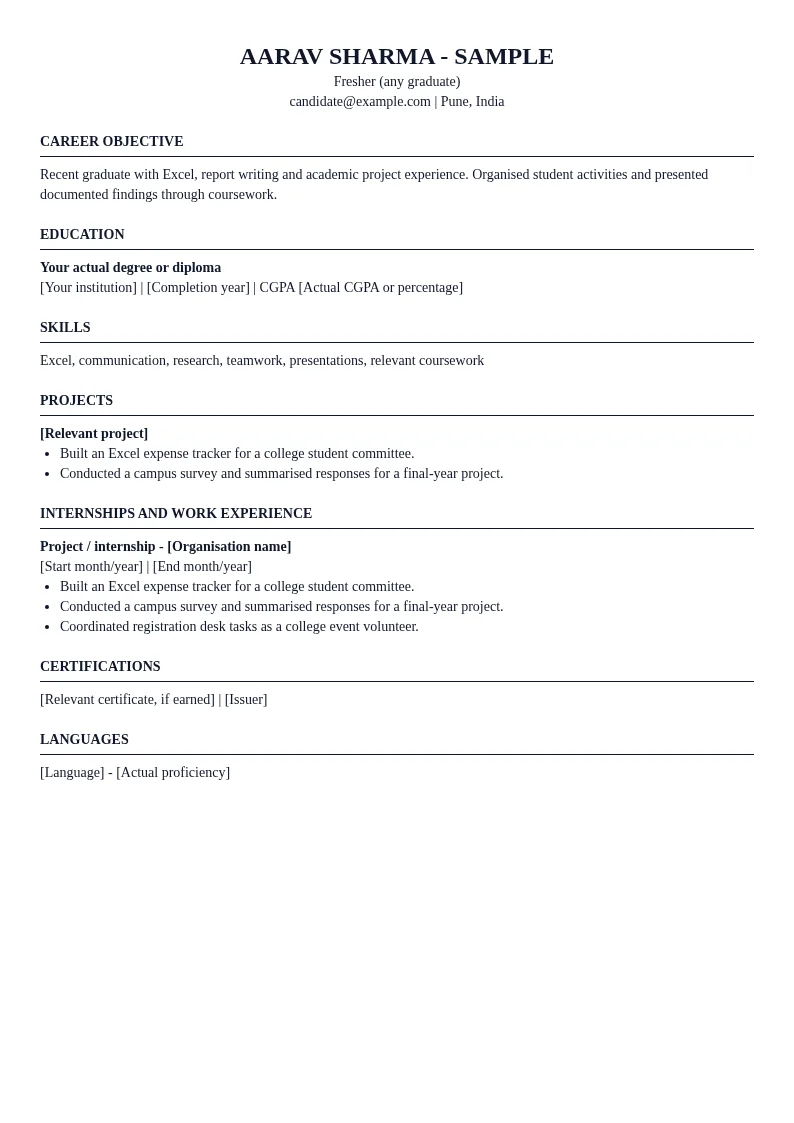
Aarav Sharma is fictional. Institution, organisation, grades and date fields are placeholders. Replace them with your real details. This is the Fresher (India) layout.
Choose a credible direction before writing
A fresher resume works best when it gives an employer a clear reason to consider you for a particular kind of work. Start by choosing a realistic target, such as junior analysis, administration, sales support, software development, or another defined function. You can maintain different applications for genuinely different interests, but each version should have a coherent focus. Indian recruiters handling entry level applications need to connect your education and evidence to the vacancy quickly. Avoid an objective that asks for any suitable opportunity while listing unrelated ambitions. Your introduction should explain what you can contribute now and the type of work you are prepared to learn, without pretending that enthusiasm replaces relevant preparation.
Find evidence outside formal employment
Limited employment history does not mean there is nothing to assess. Review coursework, internships, apprenticeships, volunteering, family business assistance, competitions, and independent practice for tasks you actually completed. Select evidence that resembles the target work: checking data, explaining information, building something, organising records, or coordinating an activity. State the setting clearly, especially when work was unpaid, academic, or simulated. Recruiters may screen for understandable communication, basic role relevant skills, and the ability to explain personal contributions. A project title alone gives little evidence. Describe the problem, your part, and the output so the reader can distinguish your work from the team's work and from material supplied by a course instructor or online tutorial.
Translate a student activity into a work example
Consider this hypothetical rewrite: • Before: Worked on a college placement event. • After: Maintained the participant list, checked incomplete entries with classmates, and prepared the final attendance sheet for the placement coordinator. This shows organisation and follow through without inventing participation figures or claiming that you secured placements. Choose an example that matches the vacancy rather than copying the event context automatically. If a task failed or remained incomplete, you can still explain what you produced and what you learned, provided you do not disguise the outcome. Use verbs that reflect your actual contribution. Supporting, testing, drafting, or checking can be more credible than leading when responsibility was shared or closely supervised throughout the activity.
Present education and work samples selectively
Keep education easy to find, using the correct course name and truthful completion status. Include marks or other academic details when requested or meaningfully relevant, not because every application must look identical. Optional certificates can support a claim, but a long collection of unrelated course badges often makes the target less clear. Provide a particular credential if the vacancy asks for it. A small portfolio should contain work you can explain independently, with borrowed material and collaboration acknowledged. For code, state what you built beyond the tutorial; for a report, identify the sources and your reasoning. Remove personal data, confidential internship material, and unfinished placeholders before sharing a link with an employer.
Use the space differently from an experienced applicant
An experienced candidate can rely on repeated workplace ownership; a fresher needs to show readiness through specific preparation and the ability to learn. Give your strongest relevant project more room than an experienced applicant normally would, but do not stretch a short exercise into a fictional job. Explain internship supervision and distinguish observation from tasks you performed. If you have substantial unrelated employment, include it honestly and draw out transferable responsibilities without disguising the industry. A career changer entering a new field should not erase earlier work simply to appear newly graduated. Where a gap exists, describe relevant activity truthfully if useful, while remembering that an application does not require an invented story for every period.
Make the application easy to verify
Four mistakes commonly weaken entry level resumes: sending the same unfocused profile to unrelated vacancies, claiming proficiency after only watching lessons, copying a project description you cannot explain, and inflating a campus position into managerial employment. Replace each with evidence the recruiter could reasonably test. Check that links open, contact details are current, dates are consistent, and the file remains readable when viewed on a phone. Include location, joining availability, or work preferences when requested, using realistic statements rather than automatic promises. Prepare to explain one piece of work from beginning to end, including where you needed help. Honest boundaries and a clear learning process give an employer a firmer basis for selection than exaggerated confidence.
Arrange the evidence for this application
Begin with contact details and a targeted objective, then your actual degree, relevant coursework and a substantial project. Follow with internships, practical skills and selected campus responsibilities. If a supervised placement provides stronger evidence than the project, move it earlier. Do not insert an empty employment heading merely to imitate an experienced candidate's layout; give the evidence you actually have space to breathe.
Key skills and tools
- Excel
- communication
- research
- teamwork
- presentations
- relevant coursework
Copy only statements that match your actual work. Replace bracketed metrics only with verified values, or remove the number. These suggested revisions are examples, not claims about a real candidate.
Fresher and project bullet examples
Built an Excel expense tracker for a college student committee.
Conducted a campus survey and summarised responses for a final-year project.
Coordinated registration desk tasks as a college event volunteer.
Prepared a literature review using cited sources for an academic dissertation.
Updated shared task sheets during a supervised office internship.
Presented a final-year project with supporting files and a clear explanation of methods.
Experienced bullet examples
Completed assigned research tasks using verified reference material.
Prepared Excel reports explaining methods and findings.
Coordinated task handovers using shared project trackers.
Presented project outcomes and responded to review questions.
Organised supporting documents for team review and handover.
Reduced measured spreadsheet processing time by [X]% through a tested formula change.
Checked submitted work for missing information and inconsistent formatting.
Analysed [N] survey records and documented recurring themes.
Maintained task status and meeting notes during a short-term assignment.
Compiled source references for reviewed reports and presentations.
Prepared PowerPoint updates summarising completed work and pending actions.
Recorded feedback and revised submitted documents for supervisor review.
Three summary examples
Recent graduate with Excel, report writing and academic project experience. Organised student activities and presented documented findings through coursework.
Early-career graduate experienced in task tracking, spreadsheet reports and team coordination. Maintains clear records and follows review feedback through to completed work.
Graduate candidate with office internship exposure and a previous background in another field. Brings transferable communication skills to research, document preparation and coordinated assignments.
Frequently asked questions
What should I write if I have no internship?
Use relevant academic work, independent practice, volunteering, or other genuine responsibilities. Explain the setting and your contribution without presenting them as employment.
Should I apply with one resume for every field?
Keep a truthful base record, then select and reorder evidence for each target. Avoid changing facts or claiming interests and skills you cannot support.
Are course certificates enough to prove a skill?
They can support your preparation, but a practical example is often more informative. Be ready to explain what you can do independently and where you still need guidance.
Can I include work done for a family business?
Yes. Identify the setting and describe genuine tasks, whether paid or unpaid. Do not invent a formal title or employment arrangement.