
Resume Ground resources
Backend developer resume example
A practical Indian backend developer resume format, with sample statements for freshers and experienced applicants.
The button opens the existing template and role-starter flow. Where no matching starter exists, start blank and copy suitable statements below.
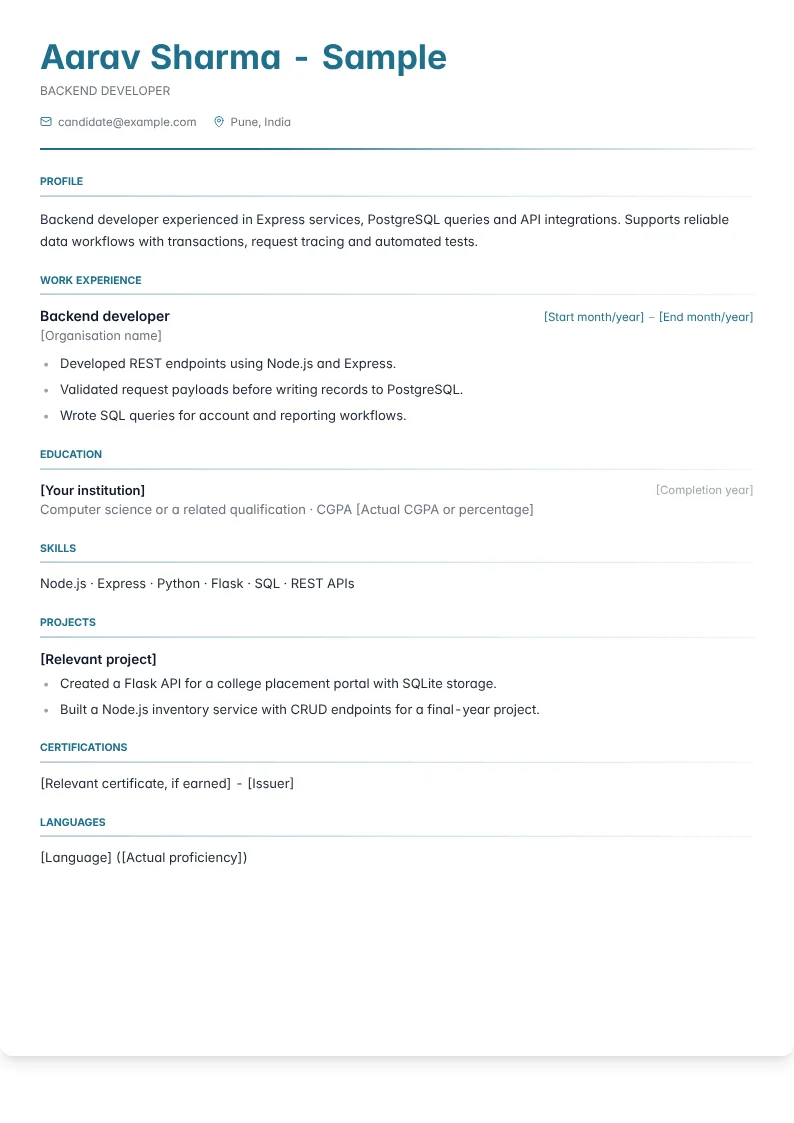
Sample resume, not a real candidate
Aarav Sharma is fictional. Institution, organisation, grades and date fields are placeholders. Replace them with your real details. This is the Modern Clean layout.
Begin with service boundaries and data responsibility
A backend developer application should make the invisible parts of a product understandable. Identify the services, data flows, or business operations you supported, then explain your responsibility within those boundaries. A recruiter in India may initially filter for programming language, framework, database exposure, and relevant service experience. The technical panel needs a deeper account of how requests are validated, data is persisted, and failures are contained. Avoid opening with a long catalogue of infrastructure names. Instead, establish whether you built transactional workflows, background processing, integrations, or internal APIs. This helps readers connect your experience to their system without assuming that familiar technology names imply familiarity with their operational problems.
Show what happens when the happy path breaks
Strong backend evidence includes the conditions under which an operation might be repeated, interrupted, rejected, or only partly completed. Describe your approach to transactions, request validation, retries, and error reporting where those concerns actually arose. Database experience becomes more credible when attached to schema choices, query investigation, migration sequencing, or consistency requirements. Security statements also need boundaries: implementing permission checks is more precise than claiming that you secured an entire platform. Explain how changes were tested and reviewed before deployment. If you investigated an incident, distinguish immediate containment from the later corrective work. Reviewers should see that you can reason about system behaviour without borrowing impressive terminology from architectures you have not operated.
Translate maintenance into a stronger bullet
This hypothetical revision shows how routine sounding work can reveal backend judgement. • Before: Worked on database issues and developed APIs for orders. • After: Added an order creation endpoint with request validation and transactional writes, then covered duplicate submissions and rollback behaviour in integration tests. The rewrite names a workflow, identifies safeguards, and offers evidence that can be discussed. It deliberately avoids invented throughput or revenue claims. Adapt it only to match your actual contribution. If someone else designed the transaction model, explain that you implemented or tested it rather than claiming the design. Supporting project notes can cover schema relationships, error responses, and why the chosen approach suited the business operation better than a simpler write sequence.
Separate entry level potential from production ownership
Freshers can demonstrate backend fundamentals through a modest service with coherent data modelling, documented endpoints, automated tests, and reproducible local setup. A meaningful business rule is more useful than a large collection of basic create and update routes. Experienced applicants should emphasise compatibility, migrations, incident response, and coordination with consumers of their APIs. Show how you handled change without assuming every caller could update immediately. A portfolio may include an API specification, a sanitised design document, or an independent service repository. Technology certificates are optional evidence, not proof of production judgement; provide a particular one if the vacancy asks for it. Never expose credentials, customer records, or internal endpoints in an example intended for recruiters.
Correct claims that invite avoidable doubt
Watch for four specific mistakes. Calling every service a microservice can exaggerate architectural responsibility. Claiming query optimisation without retaining the query context leaves the improvement impossible to assess. Showing authentication code while ignoring authorisation suggests an incomplete understanding of access control. Publishing a project with embedded secrets signals unsafe handling even when the account is only for testing. Replace these signals with accurate architecture language, explainable investigation notes, explicit permission boundaries, and safe configuration examples. Check that your setup instructions do not depend on private infrastructure. When describing a limitation, explain its consequences rather than hiding it. Technical reviewers generally gain more from a candid account of an unresolved tradeoff than from a claim of flawless scalability.
Prepare for service focused screening in India
Map the vacancy to the evidence you already have: language fluency, database work, integration ownership, and operational exposure. Some Indian hiring processes separate coding assessment from service design discussion, so prepare examples for both rather than assuming framework familiarity will carry the interview. Keep joining availability and work location preferences accurate in recruiter communication. During technical preparation, practise tracing a request across validation, business logic, persistence, external calls, and the final response. Then introduce a failure and explain what changes. Experienced candidates should also be ready to discuss reviewing another engineer's design and communicating a breaking change. Freshers can use their own project to demonstrate the same reasoning at an appropriately smaller scope without pretending to have production authority.
Arrange the evidence for this application
Use the opening summary to identify service and database responsibilities, then list recent backend work before technical projects. Give API documentation a place within the relevant entry. If your experience is academic, introduce the service project after education and keep endpoint behaviour ahead of certificates or a long framework inventory.
Key skills and tools
- Node.js
- Express
- Python
- Flask
- SQL
- REST APIs
Copy only statements that match your actual work. Replace bracketed metrics only with verified values, or remove the number. These suggested revisions are examples, not claims about a real candidate.
Fresher and project bullet examples
Created a Flask API for a college placement portal with SQLite storage.
Built a Node.js inventory service with CRUD endpoints for a final-year project.
Wrote Postman collections for an internship team's authentication endpoints.
Designed a PostgreSQL schema for a student hostel booking project.
Added input validation to a Python API under an internship mentor's review.
Documented error responses and setup commands for a portfolio backend service.
Experienced bullet examples
Developed REST endpoints using Node.js and Express.
Validated request payloads before writing records to PostgreSQL.
Wrote SQL queries for account and reporting workflows.
Handled service errors without exposing credentials or internal stack traces.
Tested API responses in Postman for valid and invalid requests.
Maintained OpenAPI documentation and local service setup notes.
Improved query execution time by [X]% through index and query changes.
Investigated service failures using request IDs and application logs.
Implemented [N] external API integrations with timeout and retry handling.
Reviewed database access checks with the development team.
Added database transactions for dependent record updates.
Built background workers with duplicate-job handling and failure logging.
Three summary examples
Backend fresher with academic projects in Python, Node.js and relational databases. Built and tested REST endpoints with validation and documented error responses.
Backend developer experienced in Express services, PostgreSQL queries and API integrations. Supports reliable data workflows with transactions, request tracing and automated tests.
Backend candidate with internship exposure to Flask APIs and a previous career in another domain. Applies SQL skills and business-process knowledge to validated service workflows.
Frequently asked questions
Should I list databases I only used in coursework?
You can include them under academic or project exposure. Keep that distinct from databases you maintained or queried professionally.
Does a backend portfolio need a frontend?
No. Clear API documentation, sample requests, tests, and setup instructions can make a service understandable without a custom interface.
How can I discuss confidential architecture?
Describe general boundaries and your decisions without sharing internal names, diagrams, credentials, or sensitive business details.
Is microservices experience essential?
Only when the vacancy makes it relevant. Honest experience with a well structured monolith can demonstrate strong backend judgement.