
Resume Ground resources
Teacher resume example
A practical Indian teacher resume format, with sample statements for freshers and experienced applicants.
The button opens the existing template and role-starter flow. Where no matching starter exists, start blank and copy suitable statements below.
Sample resume, not a real candidate
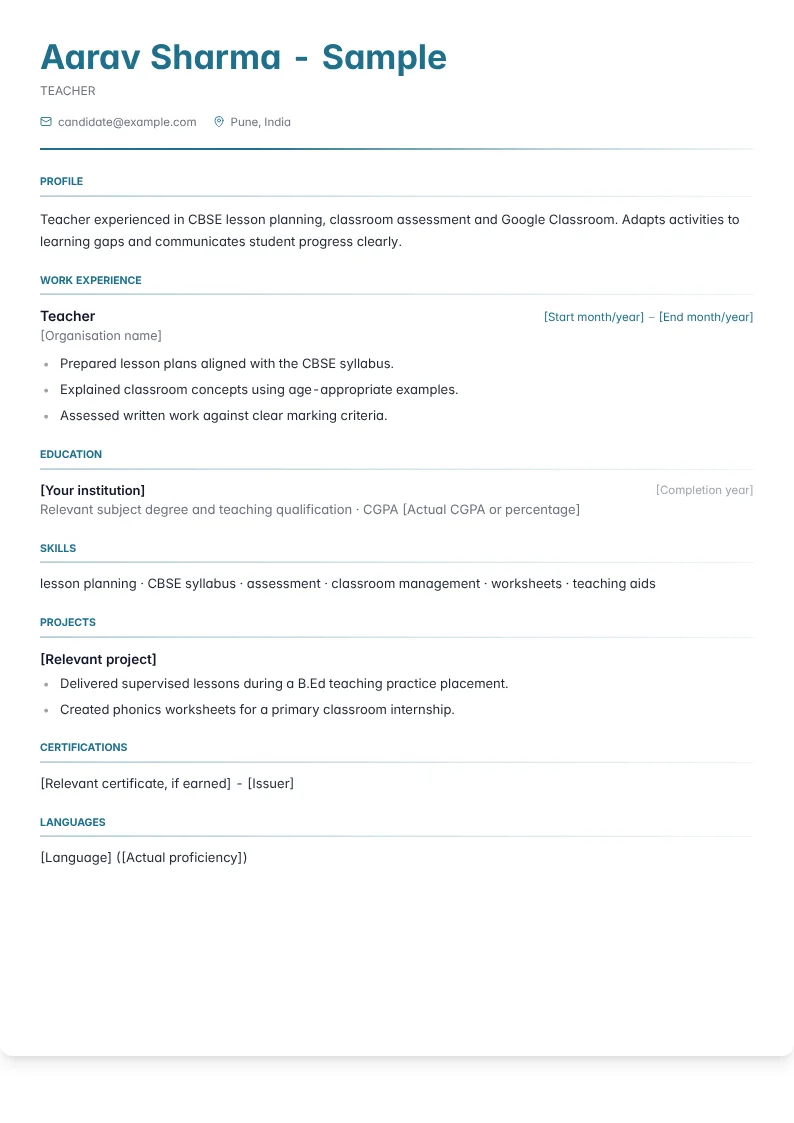
Aarav Sharma is fictional. Institution, organisation, grades and date fields are placeholders. Replace them with your real details. This is the Modern Clean layout.
Establish your classroom fit first
A teaching application should begin with the learners and subjects you are prepared to teach. State the age groups or classes, subject areas, teaching languages, and school contexts you actually know. For Indian vacancies, identify board or curriculum exposure accurately rather than treating familiarity with a textbook as classroom experience. Distinguish school teaching, private tuition, online instruction, and teaching practice so recruiters can understand the setting. If you are applying outside your previous subject or age group, explain the relevant preparation without claiming equivalent experience. Your opening should help a school place you in a realistic classroom, not merely describe a general passion for education that could fit any teaching position.
Explain what learners did in your lessons
Recruiters need more than a list of chapters completed. Describe how you introduced an idea, checked understanding, and adapted the next step when learners struggled. Examples might involve questioning, guided practice, discussion, demonstrations, or feedback on written work, depending on the subject. Make your own teaching decisions visible while avoiding unsupported claims that every learner improved. Where you worked with mixed readiness levels or multilingual classrooms, explain a practical adjustment you actually made. Mention classroom routines and respectful behaviour management through actions rather than labels such as strict or friendly. A school can assess your suitability more clearly when it sees how learning activities, assessment, and classroom organisation connected in your practice.
Present qualifications as accurate supporting evidence
List completed academic and teaching qualifications with their correct names, and distinguish ongoing study from awards already received. Eligibility examinations, training certificates, or other credentials can serve as optional evidence; provide a particular qualification or document if the vacancy asks for it. Do not assume that every school, tutoring provider, or instructional role uses identical selection criteria. A teaching portfolio can include an original lesson plan, an assessment with an explanation of what it checks, and a reflective note about adapting instruction. Use fictional learner work or properly anonymised material that you are permitted to share. Avoid uploading school records, identifiable student photographs, or parent communications simply to make the portfolio appear more authentic.
Rewrite duties as observable teaching practice
Consider this hypothetical revision: • Before: Taught science and maintained discipline. • After: Used a classroom demonstration to introduce changes of state, asked learners to explain their observations, and planned follow up practice around the misconceptions in their responses. This describes instructional choices without inventing examination results. Build your own version around a real lesson and keep the subject content accurate. If your responsibility was assisting another teacher, say what you prepared or facilitated rather than claiming sole classroom ownership. For assessment work, distinguish setting questions, administering an existing paper, marking, and discussing feedback. These details reveal your contribution more usefully than claiming responsibility for all academic progress in a class or subject.
Give freshers and experienced teachers different space
A fresher should foreground supervised teaching practice, tutoring, lesson design, subject knowledge, and reflection on feedback. Label observation placements separately from lessons you personally delivered. Explain what you changed after mentor comments, because responsiveness to guidance can be more persuasive than pretending to have mastered classroom management. An experienced teacher should prioritise sustained classroom responsibility, curriculum planning, assessment decisions, and collaboration with colleagues or families. Include mentoring or departmental duties only where they were genuinely assigned. If returning to teaching, discuss recent preparation and relevant learning without hiding the career break. Applicants moving between boards should show transferable pedagogy while being candid about which curriculum documents or assessment approaches they are still studying.
Check the application as a school would
Four mistakes deserve attention before submission. First, naming several boards without clarifying actual teaching exposure can mislead the reader. Second, attributing class results entirely to yourself overlooks prior attainment, attendance, and other influences. Third, sharing identifiable student material compromises the trust a school expects you to protect. Fourth, relying on slogans about holistic development leaves your classroom methods unexplained. Check that each important claim has a lesson, assessment, or interaction you could discuss during an interview. If a demonstration lesson is requested, prepare for the stated topic and audience rather than recycling an unrelated presentation. Keep subject expertise visible, but show that you can turn that knowledge into accessible explanations and purposeful learner activity.
Arrange the evidence for this application
Put subjects, class levels and teaching context near the top, followed by classroom roles and an optional lesson-portfolio link. Show requested qualification information prominently and accurately. A beginning teacher can place education and supervised teaching practice before other employment. Keep tuition separate from school work, and move general technology skills below teaching and assessment evidence.
Key skills and tools
- lesson planning
- CBSE syllabus
- assessment
- classroom management
- worksheets
- teaching aids
Copy only statements that match your actual work. Replace bracketed metrics only with verified values, or remove the number. These suggested revisions are examples, not claims about a real candidate.
Fresher and project bullet examples
Delivered supervised lessons during a B.Ed teaching practice placement.
Created phonics worksheets for a primary classroom internship.
Tutored schoolchildren through a college outreach programme.
Prepared a science demonstration for a teacher training assignment.
Observed classroom management and recorded reflections during a school internship.
Assessed sample answer sheets using a mentor-reviewed marking rubric.
Experienced bullet examples
Prepared lesson plans aligned with the CBSE syllabus.
Explained classroom concepts using age-appropriate examples.
Assessed written work against clear marking criteria.
Maintained attendance and student learning records.
Supported learners needing additional reading and numeracy practice.
Prepared worksheets and visual material for classroom activities.
Improved completion of assigned practice by [X]% against class records.
Shared learning progress with parents and the supervising teacher.
Prepared [N] lesson activities for classroom use.
Reviewed assessment results to identify concept gaps.
Used Google Classroom to distribute assignments and feedback.
Adapted lessons for mixed learning needs under school guidance.
Three summary examples
Teaching fresher with supervised lesson delivery and worksheet preparation. Uses syllabus-aligned examples and student assessment records to support learning.
Teacher experienced in CBSE lesson planning, classroom assessment and Google Classroom. Adapts activities to learning gaps and communicates student progress clearly.
Teaching candidate with school placement experience and a previous background in another subject profession. Combines subject knowledge with supervised classroom practice and learner-focused materials.
Frequently asked questions
Can private tuition appear as teaching experience?
Yes. Label it as private tuition and describe the learners, subjects, and teaching responsibilities accurately rather than presenting it as school employment.
Should I include student examination results?
Only use accurate information you are permitted to share, with appropriate context. Do not imply that your teaching alone caused the result.
What belongs in a teaching portfolio?
Original lesson plans, assessment examples, and brief reflections are useful. Remove identifying student information and share only material you have permission to use.
How should I list a teaching credential?
Use its exact title and completion status. Provide supporting documentation if the vacancy asks for it, without assuming every teaching role has the same criteria.