
Resume Ground resources
Nurse resume example
A practical Indian nurse resume format, with sample statements for freshers and experienced applicants.
The button opens the existing template and role-starter flow. Where no matching starter exists, start blank and copy suitable statements below.
Sample resume, not a real candidate
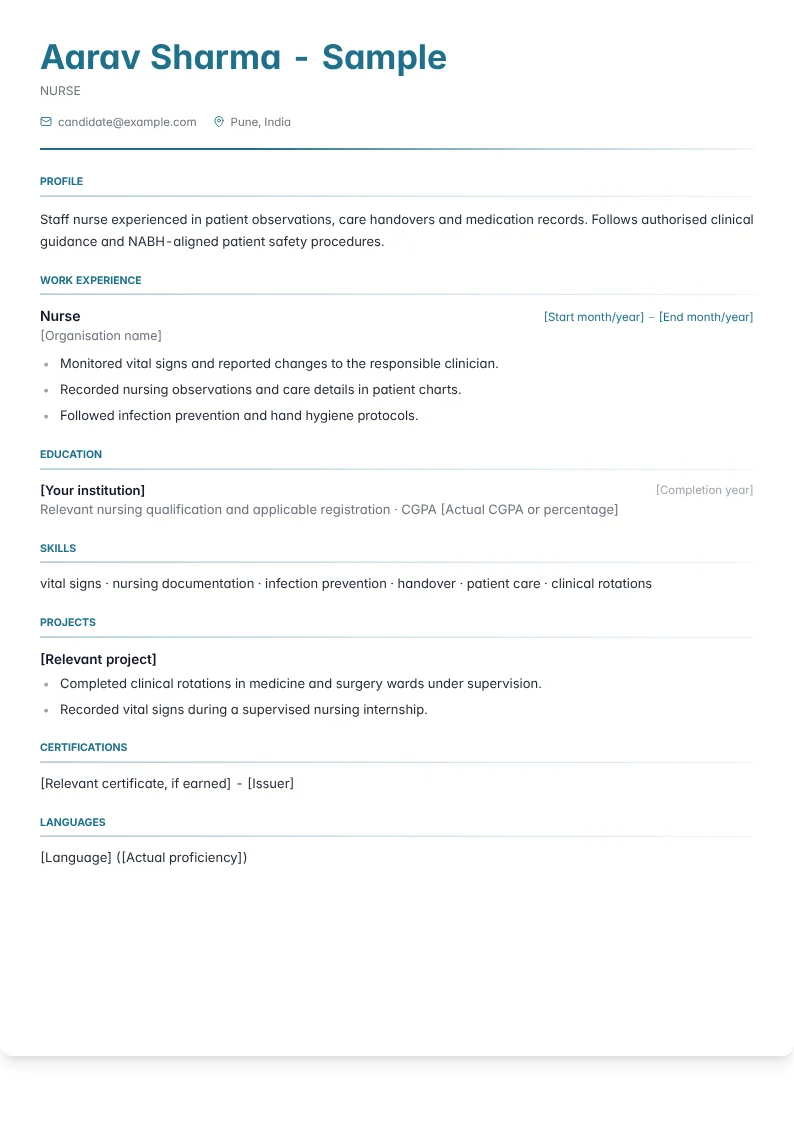
Aarav Sharma is fictional. Institution, organisation, grades and date fields are placeholders. Replace them with your real details. This is the Modern Clean layout.
Make the care setting and responsibility clear
A nursing resume should first establish the care environment in which you have worked or trained. Identify relevant wards, outpatient services, community settings, or other placements without presenting brief observation as independent practice. Indian recruiters need to understand your patient care exposure, the supervision available, and the responsibilities you were assigned. Use the employer's terminology where it accurately matches your experience, but avoid listing specialised areas merely because you passed through them during training. Your summary should communicate safe, attentive practice rather than promise expertise across every setting. If you are changing specialties, identify transferable experience and learning needs honestly so the application supports an appropriate assessment of your readiness for that role.
Describe safe care through your actual actions
Useful experience statements explain observation, documentation, communication, and escalation within your assigned scope. Describe how you contributed to care plans, prepared patients for procedures, supported comfort, or handed over relevant information, where these were genuinely part of your work. Recruiters may screen for dependable records, awareness of changing patient needs, teamwork, and respectful communication with patients and attendants. Avoid wording that implies independent diagnosis, prescribing, or procedure authority you did not possess. Where a task was supervised, make that clear. Mention adherence to the workplace's protocols without inventing universal clinical rules. The aim is to show that you recognise responsibility boundaries and communicate concerns appropriately, not to compress a clinical manual into your resume.
Handle education and registration details carefully
Present your nursing education using the exact qualification title and truthful completion status. Include placements as placements and distinguish them from employed nursing roles. Council or registration details should be included only if the vacancy asks for it; do not assume a guessed requirement applies to every position or location. Respond accurately to the wording of that vacancy and avoid implying a status you do not hold. Relevant courses can provide optional evidence of preparation, but distinguish attendance from assessed competence and avoid presenting expired training as current. A portfolio might contain a fictional handover example, a reflective learning note, or a patient education resource you created without including identifiable information or restricted workplace material.
Use a rewrite that respects clinical boundaries
A concrete hypothetical example is: • Before: Managed patients and assisted doctors. • After: Recorded assigned patient observations, documented changes, and communicated concerns to the supervising nurse during care and handover. The revision identifies observable work without inventing recovery outcomes or extending your authority. Choose your own example from a task you can discuss confidently and within confidentiality limits. If you supported a procedure, describe the preparation or assistance you actually provided rather than naming the procedure as though you independently performed it. For patient education, explain the approved information you reinforced and how you checked understanding, while avoiding claims that a single conversation guaranteed adherence or prevented a complication in every case.
Separate supervised learning from established practice
Fresh applicants should give meaningful detail about clinical placements, supervised responsibilities, reflective learning, and communication with the care team. Do not convert exposure to a ward into a claim of specialist competence. Describe feedback that helped you improve documentation, prioritisation, or patient interaction without revealing a patient's identity. Experienced nurses should emphasise their actual care setting, handover responsibilities, coordination, and any assigned mentoring or shift duties. Distinguish participating in an emergency response from leading it. If returning after time away, state recent learning and any structured preparation honestly rather than hiding the gap. Applicants changing care environments should explain transferable practice while acknowledging that local systems, equipment, and protocols may require orientation.
Review for confidentiality and credibility
Several mistakes can create serious concerns during screening. Sharing patient photographs or identifiable case histories is not an acceptable shortcut to demonstrating experience. Listing unfamiliar procedures as skills overstates readiness and can undermine safe placement. Using vague phrases such as handled all emergencies conceals your actual contribution. Claiming independent authority for work performed under supervision misrepresents responsibility. Replace these with precise descriptions that you could explain in an interview without discussing identifiable patients. Check that dates, placement labels, and qualification status agree throughout the application. When an employer requests shift or location preferences, answer realistically. A credible nursing resume shows careful observation, respectful care, and appropriate escalation rather than dramatic stories or unsupported claims of saving lives.
Arrange the evidence for this application
Use the opening area for care setting and actual qualification status; include verified council information if the vacancy asks for it. Follow with employed nursing duties, then distinct clinical placements and relevant learning. A new applicant can put education before supervised rotations. Keep ward exposure and patient-care responsibilities together rather than leading with an undifferentiated procedure list.
Key skills and tools
- vital signs
- nursing documentation
- infection prevention
- handover
- patient care
- clinical rotations
Copy only statements that match your actual work. Replace bracketed metrics only with verified values, or remove the number. These suggested revisions are examples, not claims about a real candidate.
Fresher and project bullet examples
Completed clinical rotations in medicine and surgery wards under supervision.
Recorded vital signs during a supervised nursing internship.
Assisted a clinical instructor with patient hygiene and mobility care.
Practised sterile dressing technique in a nursing skills laboratory.
Prepared a patient care plan for a supervised clinical case study.
Participated in a community health placement and documented health education sessions.
Experienced bullet examples
Monitored vital signs and reported changes to the responsible clinician.
Recorded nursing observations and care details in patient charts.
Followed infection prevention and hand hygiene protocols.
Assisted with patient care according to authorised clinical instructions.
Communicated patient concerns during nursing rounds.
Prepared ward equipment and checked supplies before procedures.
Improved completion of care documentation by [X]% against ward audit records.
Provided patient education using approved discharge guidance.
Maintained medication administration records within assigned nursing duties.
Coordinated shift handovers with pending care information.
Followed NABH-aligned ward checklists for patient identification and safety.
Checked dressing supplies and documented wound care under clinical direction.
Three summary examples
Nursing graduate with supervised clinical rotations and patient care documentation. Practised vital sign monitoring, infection prevention and safe ward routines.
Staff nurse experienced in patient observations, care handovers and medication records. Follows authorised clinical guidance and NABH-aligned patient safety procedures.
Nursing candidate with clinical internship exposure and prior experience in another care-related field. Brings patient communication skills to supervised ward care and accurate nursing records.
Frequently asked questions
Should I include council or registration information?
Include council or registration details only if the vacancy asks for it. State your actual status accurately and do not assume requirements from an unrelated vacancy.
Can clinical placements appear under experience?
Yes, with a clear placement or supervised training label. Explain the setting and tasks without presenting them as independent employment.
May I describe an interesting patient case?
Discuss your learning or contribution without identifiable details. Do not attach patient records, photographs, or confidential workplace material.
How should I list a procedure I only assisted with?
Describe the assistance you provided and the supervision involved. Do not list the procedure in a way that implies independent competence.