
Resume Ground resources
Full stack developer resume example
A practical Indian full stack developer resume format, with sample statements for freshers and experienced applicants.
The button opens the existing template and role-starter flow. Where no matching starter exists, start blank and copy suitable statements below.
Sample resume, not a real candidate
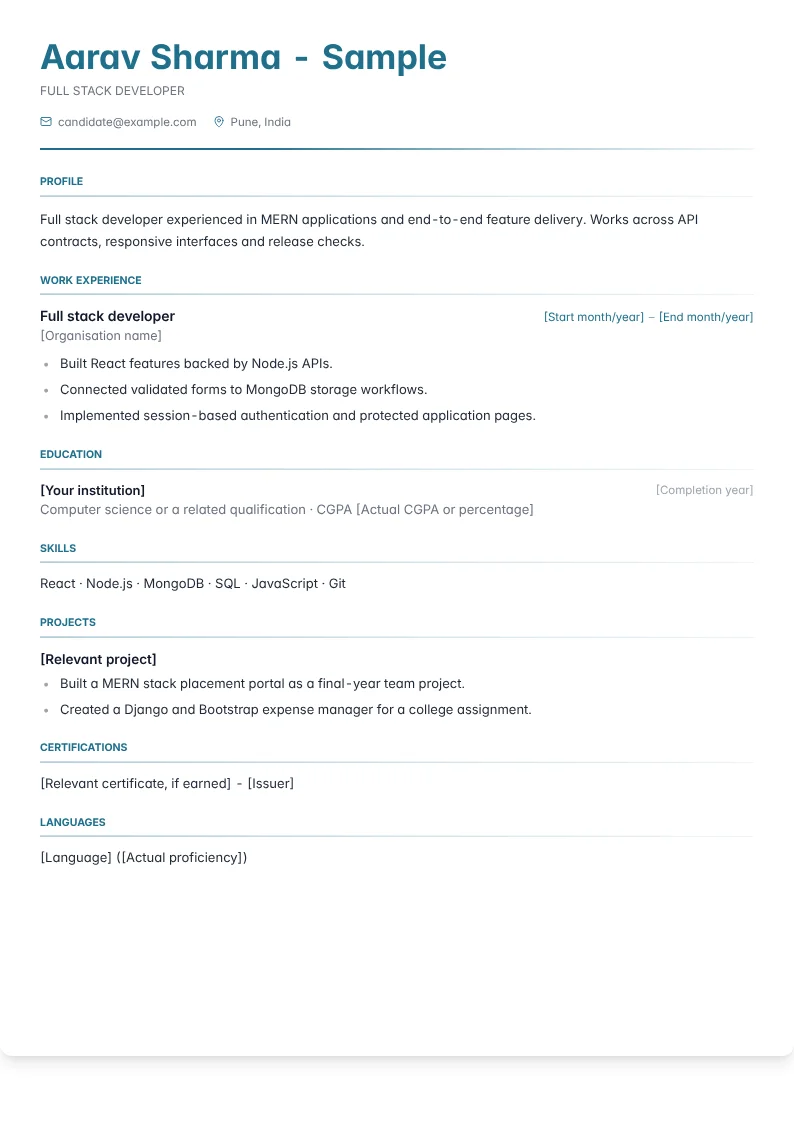
Aarav Sharma is fictional. Institution, organisation, grades and date fields are placeholders. Replace them with your real details. This is the Modern Clean layout.
Define your actual span of ownership
Full stack should describe connected work across an application, not equal mastery of every tool in its ecosystem. Start by identifying the frontend and backend technologies you use confidently, then show a feature that crossed that boundary. Recruiters in India often need to establish whether your experience matches a particular stack and whether your contribution was genuinely hands on at both ends. Make any stronger specialisation explicit rather than disguising it. An application can credibly present you as frontend leaning or backend leaning while still demonstrating end to end delivery. What matters is whether you understand how interface decisions, API contracts, persistence, and deployment constraints affect the same user task.
Tell the story of a complete workflow
Choose experience entries that connect behaviour visible to users with the work required behind it. For an approval workflow, that might include form validation, permission checks, state transitions, stored records, and feedback when an action cannot be completed. Explain where you collaborated rather than implying solitary ownership of the entire product. The most persuasive account identifies a cross layer decision: perhaps the interface needed a different response shape, or a business rule belonged on the server rather than only in a form. Describe testing at the boundaries as well as within individual components. This shows integration judgement and prevents the resume from reading like separate frontend and backend skill lists pasted together without context.
Select a portfolio that survives inspection
A full stack portfolio should make the whole application usable and explainable. Provide a safe demonstration path, setup notes, a simple architecture sketch, and an account of any external services. Use synthetic records rather than real customer information. Freshers should prioritise a coherent workflow over adding loosely connected features to look comprehensive. Experienced developers can provide greater value by discussing releases, contract changes, observability, and coordination across specialists. If employment confidentiality prevents sharing code, an independent application or authorised case study can still establish breadth. Courses and platform certificates are optional supporting material; supply a requested credential if the vacancy asks for it. Neither a certificate nor a deployed template proves that you understand the application's moving parts.
Show integration in the bullet rewrite
The following hypothetical example replaces an empty breadth claim with a connected implementation. • Before: Developed frontend and backend modules for a management application. • After: Delivered a leave request workflow connecting a validated React form to permission checked API actions, stored approval states, and status feedback for employees and managers. This version lets an interviewer ask about state ownership, access rules, and communication between layers. It does not imply business savings that were never measured. Adjust the technologies and behaviours to match your history, and identify collaborators in surrounding context. If you implemented the interface but only consumed an existing API, say so. Breadth remains credible when the boundary of your contribution is precise rather than expansive.
Resolve four common breadth problems
Four errors can undermine a full stack profile. Listing several incompatible stacks without project evidence makes depth difficult to judge. Describing client validation as sufficient protection overlooks server enforcement. Presenting a deployed demo without explaining configuration or data handling conceals important delivery work. Claiming sole ownership when design, infrastructure, or testing came from teammates misrepresents collaboration. Address each through a focused stack summary, clear validation responsibilities, documented operating assumptions, and named contribution boundaries. Also inspect whether your project behaves consistently when a request fails or a user refreshes mid workflow. Those details often reveal more integration understanding than another framework logo. The goal is a believable account of connected decisions, not an assertion that you can replace every specialist.
Adapt your evidence to the vacancy
Read the role description for where the work is concentrated. A small product team may value independent feature delivery, while a larger organisation may expect depth in one layer alongside effective collaboration with another. Tailor the order of examples accordingly without changing the facts. In Indian recruiter conversations, clarify stack recency, project responsibilities, joining constraints, and willingness to work under the advertised arrangement. For interviews, prepare to trace a user action through the browser, network, service logic, and database, then back to visible feedback. Explain where you would add tests and how you would investigate a failure. Experienced applicants should include a change that required coordination; freshers can demonstrate disciplined reasoning through the boundaries of their own application.
Arrange the evidence for this application
Arrange a working application link, stack summary and connected feature entries together so the reader can follow both layers. Experienced candidates can lead with delivered workflows; graduates should pair education with the strongest end-to-end project. Keep frontend and backend skills grouped separately beneath those examples rather than scattering duplicate tool lists throughout the document.
Key skills and tools
- React
- Node.js
- MongoDB
- SQL
- JavaScript
- Git
Copy only statements that match your actual work. Replace bracketed metrics only with verified values, or remove the number. These suggested revisions are examples, not claims about a real candidate.
Fresher and project bullet examples
Built a MERN stack placement portal as a final-year team project.
Created a Django and Bootstrap expense manager for a college assignment.
Implemented cart and checkout simulations in a portfolio e-commerce application.
Connected an internship team's React form to a reviewed Express endpoint.
Tested login and password reset flows on an internship staging application.
Deployed a student event booking project with documented environment variables.
Experienced bullet examples
Built React features backed by Node.js APIs.
Connected validated forms to MongoDB storage workflows.
Implemented session-based authentication and protected application pages.
Tested user journeys from form submission to saved records.
Fixed defects spanning React state and Express request handlers.
Maintained environment setup notes and release checklists.
Reduced feature response time by [X]% after profiling network and database calls.
Reviewed frontend and backend changes for validation gaps.
Delivered [N] scoped web features against approved user stories.
Coordinated API contract changes with interface developers.
Added server-side pagination to searchable application lists.
Configured CI checks for frontend tests and backend linting.
Three summary examples
Full stack fresher with React, Node.js and MongoDB project work. Built academic web applications with authentication, forms and tested data flows.
Full stack developer experienced in MERN applications and end-to-end feature delivery. Works across API contracts, responsive interfaces and release checks.
Web development candidate with full stack internship exposure and transferable experience from another field. Combines Django or JavaScript projects with an understanding of complete user workflows.
Frequently asked questions
Must I be equally strong in frontend and backend?
No. State your stronger area and support your working competence in the other with a connected feature example.
Should I include deployment experience?
Include what you actually handled, such as configuration, release steps, or environment troubleshooting. Do not imply infrastructure ownership from a simple hosted deployment.
Is a clone application useful?
It can be, provided you acknowledge its inspiration and explain original implementation decisions rather than presenting copied behaviour as product innovation.
How many technology stacks should I emphasise?
Emphasise the stack most relevant to the vacancy and best supported by your work. Additional tools should not obscure that evidence.