
Resume Ground resources
Software engineer resume example
A practical Indian software engineer resume format, with sample statements for freshers and experienced applicants.
The button opens the existing template and role-starter flow. Where no matching starter exists, start blank and copy suitable statements below.
Sample resume, not a real candidate
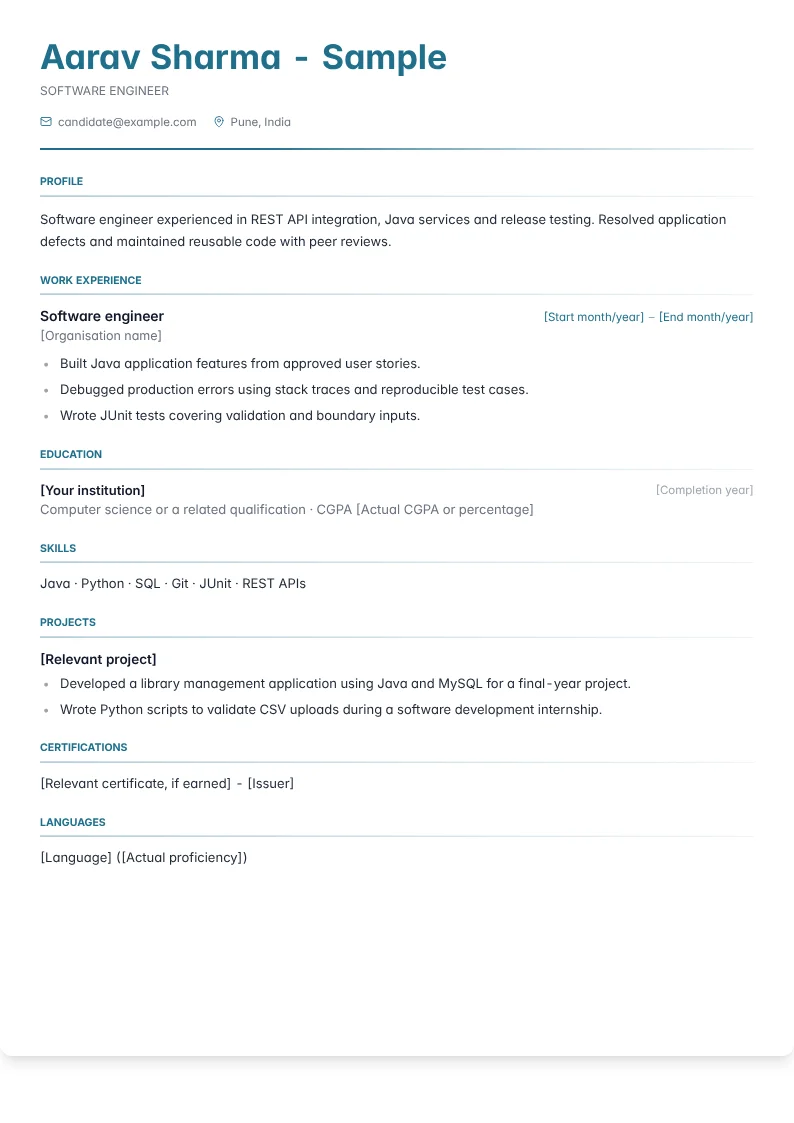
Aarav Sharma is fictional. Institution, organisation, grades and date fields are placeholders. Replace them with your real details. This is the Modern Clean layout.
Show how you reason about software
A software engineer application should reveal how you turn an ambiguous problem into dependable behaviour. Open with the kind of systems you have worked on, your strongest programming language, and the decisions you can explain in an interview. Avoid presenting yourself as equally capable across every technical discipline. Recruiters hiring in India may first check language alignment, relevant experience, location preferences, and notice period before a technical reviewer examines implementation depth. Make those practical details easy to find without crowding the opening paragraph. Your strongest evidence is usually a feature or system you understood beyond your assigned ticket, including its interfaces, failure conditions, tests, and maintenance implications.
Build experience entries around engineering decisions
Describe work through the problem, your responsibility, the choice you made, and the evidence that the change behaved as intended. Naming a framework is less useful than explaining why you changed an interface, isolated a dependency, or added defensive handling. Distinguish personal contribution from team delivery, especially when several engineers shared a service. If production measurements are unavailable, discuss verified behaviour, review acceptance, or a resolved failure mode rather than manufacturing impact. Campus projects can support the same reasoning when their constraints are clear. A reader should be able to identify what you owned, what you learned from the system, and which tradeoffs you would reconsider under different operating conditions.
Choose evidence for your career stage
For freshers, a substantial academic or independent project can demonstrate data structures, debugging, version control, and readable code together. Explain the problem before naming the stack, and identify any starter code or tutorial foundation honestly. Experienced applicants should give more space to architecture boundaries, compatibility, incident learning, and collaboration across teams. A public repository is helpful when it includes setup instructions, tests, and a concise design explanation, but confidential employment work should remain private. A sanitised technical case study can substitute for source access. Degrees, coursework, and certificates are optional supporting evidence unless the employer specifies otherwise; attach documentary proof if the vacancy asks for it, not as a substitute for engineering examples.
Rewrite a responsibility into a defensible contribution
Consider this hypothetical rewrite for an engineer who handled a fragile integration. The improved version does not claim an unmeasured commercial benefit; it gives the interviewer concrete implementation choices to explore. • Before: Responsible for API integration and bug fixing. • After: Reworked the payment callback handler to validate incoming events, recognise repeated requests, and cover retry behaviour with integration tests. Use this wording only if those actions reflect the actual work. If your contribution stopped at diagnosis, say that instead of implying ownership of the fix. Supporting context can explain how you reproduced the failure and coordinated review. Keep the bullet readable, then reserve the full design narrative for a project note or interview discussion.
Remove signals that weaken technical credibility
Four mistakes frequently make an otherwise plausible application harder to trust. First, an undifferentiated skills list suggests keyword collection when the experience section cannot substantiate it. Second, claiming ownership of an entire platform obscures the component you actually built. Third, describing every change as scalable or optimised invites questions that vague evidence cannot answer. Fourth, publishing employer code or internal screenshots creates confidentiality concerns. Replace these weaknesses with a selective skills inventory, clear boundaries, explicit verification, and safe examples. Check that repository links work without special permissions. Read every claim as an interviewer might: you should be able to explain the original behaviour, your reasoning, an alternative approach, and any remaining limitations.
Prepare for Indian hiring conversations
Keep a consistent account of employment dates, project assignments, and current availability across your resume and application forms. Where an Indian recruiter requests current compensation, expected compensation, or notice period, answer accurately through the requested channel rather than embedding sensitive details in a public portfolio. Prepare separate explanations for coding decisions and team interactions: technical rounds may probe implementation, while managerial conversations may examine ambiguity and accountability. If applying across product companies, service firms, and internal technology teams, adjust the evidence to the vacancy rather than changing your underlying history. Close your preparation by rehearsing a feature walkthrough that covers requirements, code structure, tests, deployment considerations, and what you would improve next.
Arrange the evidence for this application
Place your primary language and system responsibility in a short summary, followed by recent engineering roles and selected design decisions. Keep education after work once employed. For campus applications, put education and the strongest original implementation ahead of unrelated jobs; link its repository beside the project rather than burying it among certificates.
Key skills and tools
- Java
- Python
- SQL
- Git
- JUnit
- REST APIs
Copy only statements that match your actual work. Replace bracketed metrics only with verified values, or remove the number. These suggested revisions are examples, not claims about a real candidate.
Fresher and project bullet examples
Developed a library management application using Java and MySQL for a final-year project.
Wrote Python scripts to validate CSV uploads during a software development internship.
Built a student attendance tracker with login and report downloads for a college project.
Tested exception handling in a Spring Boot service under a mentor's review.
Created SQL seed fixtures for an internship team's local test environment.
Presented a working expense tracker with source code and test results at a project review.
Experienced bullet examples
Built Java application features from approved user stories.
Debugged production errors using stack traces and reproducible test cases.
Wrote JUnit tests covering validation and boundary inputs.
Reviewed pull requests in GitHub and documented code changes.
Integrated REST APIs with input validation and exception handling.
Maintained release branches and resolved merge conflicts in Git.
Reduced API response time by [X]% after profiling database calls.
Documented application setup and deployment steps for new developers.
Resolved [N] defects reported in Jira during release testing.
Supported application releases with smoke tests and rollback checks.
Refactored duplicated business logic into reusable service methods.
Implemented structured logging to trace failures across application layers.
Three summary examples
Computer science graduate with project experience in Java, Python and SQL. Built academic applications with Git version control and unit testing.
Software engineer experienced in REST API integration, Java services and release testing. Resolved application defects and maintained reusable code with peer reviews.
Early-career developer with software internship work and previous experience outside technology. Combines practical Python and MySQL projects with structured debugging and clear technical documentation.
Frequently asked questions
Should I list every programming language I have used?
Prioritise languages you can discuss and use during assessment. Label limited academic exposure clearly rather than presenting it as professional proficiency.
Can I apply without a public GitHub profile?
Yes. Clear experience descriptions, a sanitised design note, or an independently built sample can provide evidence without exposing confidential code.
Where should I mention my notice period?
Use the application field or recruiter conversation when requested. Keep the information consistent with your actual employment terms.
How should I describe unfinished projects?
State what works, what you personally implemented, and what remains incomplete. Do not describe a prototype as a production deployment.