
Resume Ground resources
HR recruiter resume example
A practical Indian hr recruiter resume format, with sample statements for freshers and experienced applicants.
The button opens the existing template and role-starter flow. Where no matching starter exists, start blank and copy suitable statements below.
Sample resume, not a real candidate
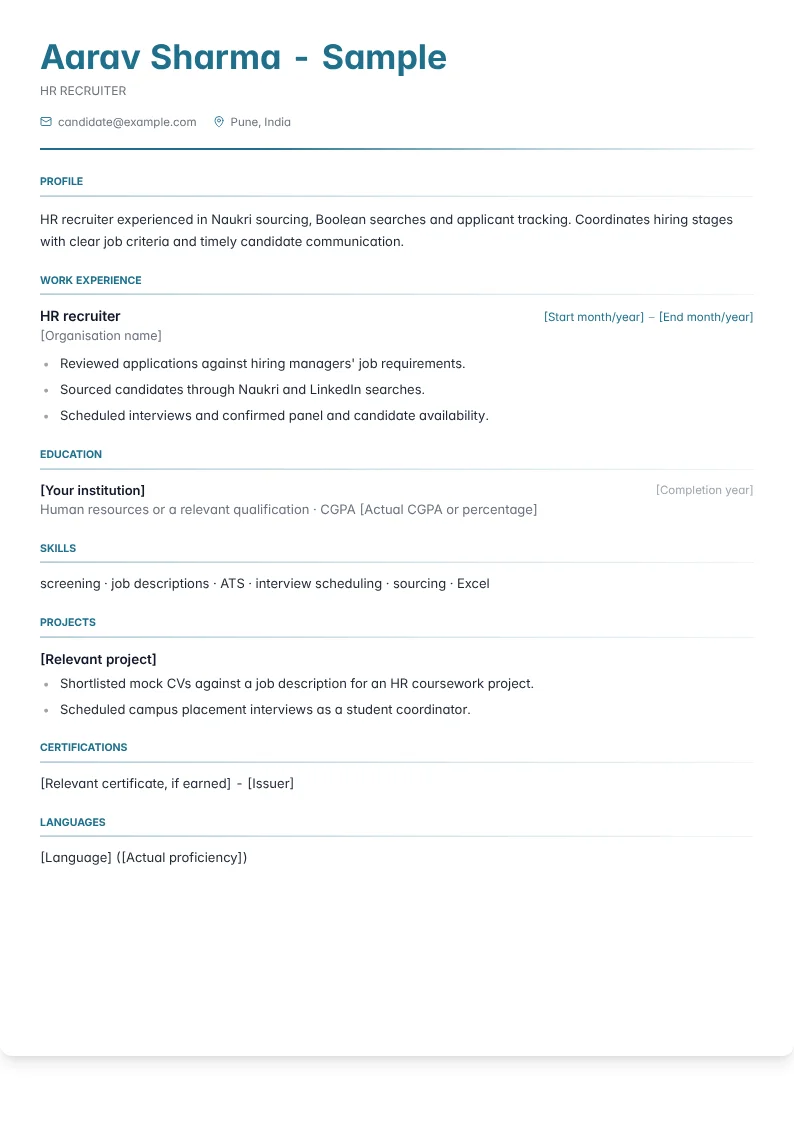
Aarav Sharma is fictional. Institution, organisation, grades and date fields are placeholders. Replace them with your real details. This is the Modern Clean layout.
Tell the hiring team which recruitment problems you know
An HR recruiter resume should identify the hiring environment, role families, and stages of recruitment you handled. Technology sourcing, frontline hiring, specialist search, and campus coordination require different examples. Indian employers may also distinguish staffing agency experience from internal talent acquisition because client management and business priorities differ. State whether you supported permanent hiring, contractual staffing, or another arrangement, using only categories relevant to your work. A clear introduction explains the candidates you approached and the hiring stakeholders you served. Avoid opening with a claim of end-to-end recruitment unless you can explain your involvement from requisition clarification through the actual joining stage, including where approvals and final selection remained with other people.
Show how you translated a vacancy into a search
Good recruitment begins before profiles are collected. Describe how you clarified essential skills, understood the working arrangement, and separated genuine requirements from preferences. Explain the search methods you used and why they suited the role, whether that involved job portals, professional networks, referrals, or local outreach. A recruiter screening your application may ask how you adjusted when the initial candidate pool was unsuitable. Demonstrate reasoning rather than just naming platforms. In India, location, notice period, compensation expectations, and willingness to work the advertised schedule can affect fit. Present these as points to clarify with candidates, not assumptions to make from their background, current employer, or the city listed on their resume.
Demonstrate screening quality and candidate care
Explain what you assessed during a screening conversation and how you documented evidence for the hiring manager. For technical recruitment, distinguish understanding a role's vocabulary from independently validating deep technical capability. For nontechnical hiring, show how you checked relevant responsibilities instead of relying on job titles alone. Candidate communication also matters: describe scheduling, interview preparation, updates, and follow-up without implying that you could guarantee selection. Recruiters may probe how you handled a withdrawal, delayed feedback, or a mismatch discovered late in the process. Respectful communication and accurate notes are stronger signals than describing candidates as inventory. Keep personal information limited to what is appropriate for the hiring process and authorised by your organisation.
Use pipeline evidence without taking shared credit
A useful bullet should show the judgement behind moving a candidate forward. Hypothetical rewrite: • Before: Sourced candidates and closed positions through job portals. • After: Refined the search for customer support applicants after clarifying shift expectations, recorded screening evidence against the agreed brief, and coordinated shortlisted candidates with the interview panel. This version shows search adjustment, assessment structure, and coordination without inventing hiring outcomes. If you have documented hiring results, distinguish candidates sourced, screened, offered, accepted, and joined. These stages are not interchangeable. Also explain whether a result was individual or team-based. Do not claim sole credit for a hire when assessment, offer approval, and candidate conversion were shared across the recruitment team and hiring manager.
Present suitable proof for your level of experience
Freshers can use recruitment internships, placement activities, or an original mock search plan to demonstrate understanding of a hiring brief. Be explicit about whether you observed interviews, scheduled them, or conducted screening yourself. Experienced recruiters should show role complexity, stakeholder management, search refinement, and the handling of difficult hiring constraints. A public candidate database is never an appropriate portfolio. Instead, use fictional screening templates, anonymised process explanations, or sample search logic that contains no personal information. Recruitment training and HR qualifications can be optional supporting evidence; include a particular credential if the vacancy asks for it. Relevant language skills may help in some Indian hiring contexts, but describe your actual ability to conduct clear candidate conversations.
Avoid shortcuts that weaken recruiter credibility
Four mistakes regularly cause concern: equating profile submission with a successful hire, copying technical keywords without understanding their relevance, claiming end-to-end ownership when you only scheduled interviews, and sharing candidate resumes without appropriate permission. Correct these before adding more achievement language. Prepare examples showing how you challenged an unclear brief, recovered communication after delayed feedback, and recognised a candidate mismatch respectfully. Keep your own employment history and notice period accurate; recruiters are expected to practise the same clarity they request from applicants. Tailor the resume to agency, in-house, volume, or specialist hiring as appropriate. The strongest narrative shows that you can improve the quality of a hiring conversation rather than merely move more profiles between inboxes.
Arrange the evidence for this application
Use the profile to identify hiring domains and stages handled, then show sourcing and screening responsibilities. Place ATS experience next to candidate tracking evidence and keep interview coordination distinct. A graduate can lead with education and a mock screening assignment labelled as practice. General HR courses should follow evidence of understanding the roles you screened.
Key skills and tools
- screening
- job descriptions
- ATS
- interview scheduling
- sourcing
- Excel
Copy only statements that match your actual work. Replace bracketed metrics only with verified values, or remove the number. These suggested revisions are examples, not claims about a real candidate.
Fresher and project bullet examples
Shortlisted mock CVs against a job description for an HR coursework project.
Scheduled campus placement interviews as a student coordinator.
Updated an Excel candidate tracker during a recruitment internship.
Drafted role advertisements under a talent acquisition mentor's review.
Observed screening calls and recorded job-related notes during an internship.
Prepared a sourcing plan for an entry-level accounts role in a college assignment.
Experienced bullet examples
Reviewed applications against hiring managers' job requirements.
Sourced candidates through Naukri and LinkedIn searches.
Scheduled interviews and confirmed panel and candidate availability.
Maintained candidate stages in the applicant tracking system.
Explained role scope, location and hiring steps to applicants.
Collected interview feedback and recorded follow-up actions.
Reduced interview scheduling time by [X]% through shared calendar coordination.
Prepared weekly hiring pipeline reports for recruitment reviews.
Screened [N] applications using documented role criteria.
Coordinated offer documentation with the HR operations team.
Used Boolean searches to shortlist technical skill profiles.
Tracked offer acceptance and joining-date confirmations.
Three summary examples
Recruitment fresher with campus placement coordination and HR internship exposure. Practised CV screening, candidate tracking and interview scheduling.
HR recruiter experienced in Naukri sourcing, Boolean searches and applicant tracking. Coordinates hiring stages with clear job criteria and timely candidate communication.
Recruitment candidate with talent acquisition internship work and a background in customer communication. Applies listening and coordination skills to screening calls, interview planning and joining follow-ups.
Frequently asked questions
Can I become a recruiter without an HR degree?
Yes, depending on the employer. Demonstrate communication, search skills, accurate coordination, and understanding of the role. Provide a particular qualification if the vacancy asks for it.
How should I describe technical recruitment experience?
Name the role families you recruited for and explain your search and screening responsibilities. Do not imply that you performed specialist technical assessment unless you genuinely did.
Should I include the names of candidates I placed?
No. Describe the role and your contribution without exposing candidate identities or private employment information.
What does end-to-end recruitment mean on a resume?
It should reflect genuine involvement across the recruitment process, with clear boundaries around selection and approvals. If you handled only certain stages, name those stages instead.