
Resume Ground resources
Product manager resume example
A practical Indian product manager resume format, with sample statements for freshers and experienced applicants.
The button opens the existing template and role-starter flow. Where no matching starter exists, start blank and copy suitable statements below.
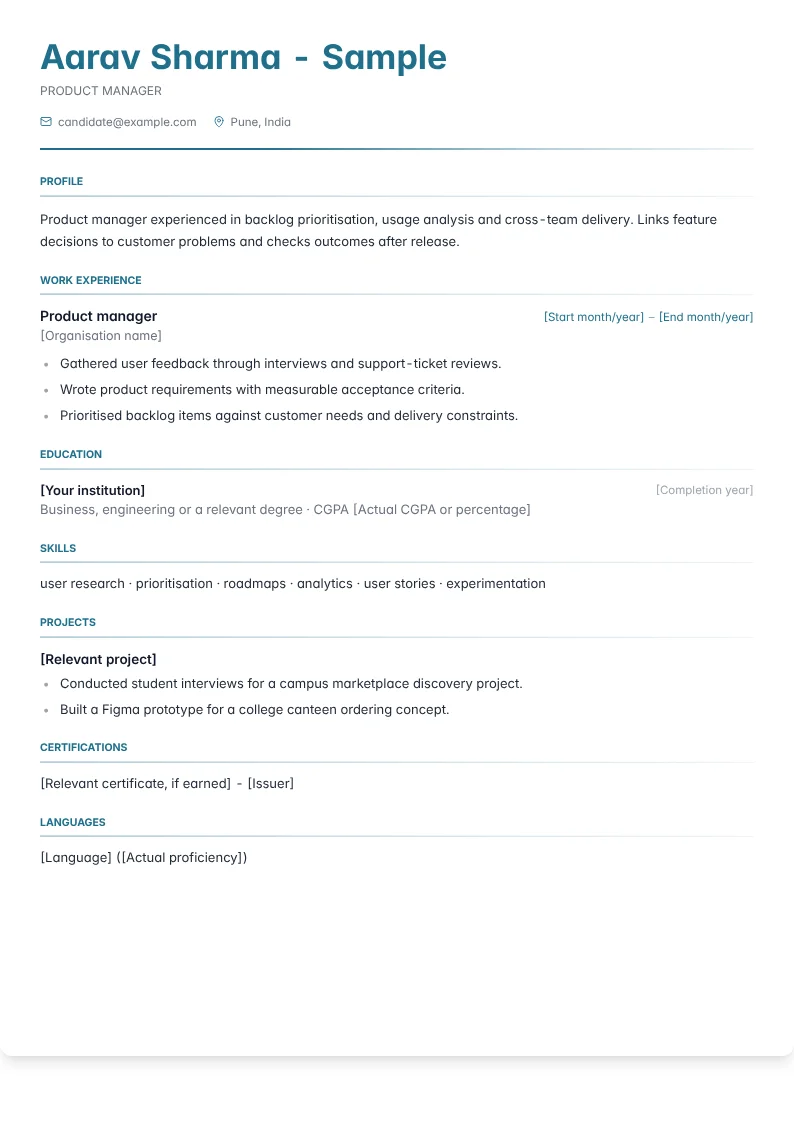
Sample resume, not a real candidate
Aarav Sharma is fictional. Institution, organisation, grades and date fields are placeholders. Replace them with your real details. This is the Modern Clean layout.
Establish the product decisions you actually owned
A product manager application should explain what you were responsible for deciding, not simply which ceremonies you attended. Start with the product, its users, its business context, and your ownership boundaries. A recruiter hiring for an Indian consumer app may seek different evidence from one filling an enterprise software or internal platform vacancy. Make your setting explicit. Clarify whether you identified problems, shaped priorities, coordinated launches, or monitored a particular product area. If final decisions belonged to a founder or product lead, describe your contribution accurately. A focused introduction helps the reader distinguish product management from project coordination, account servicing, business analysis, and general operations without dismissing the value of those related experiences.
Put discovery before the feature list
Explain how you learned what users needed and how that evidence influenced a choice. Useful material includes interview synthesis, support-ticket themes, behavioural analysis, usability observations, and conversations with customer-facing colleagues. State the limitations of your evidence when they mattered. A handful of vocal customers does not automatically represent the whole market. Show how you separated the underlying problem from a requested feature and considered an alternative response. Indian hiring teams may probe whether your discovery reached actual users or only internal stakeholders. Be prepared to explain recruitment constraints, language considerations, and disagreements. Your resume need not contain the entire research story, but it should make your reasoning available for an interview.
Connect prioritisation, delivery, and evaluation
A strong experience section shows the trade-offs behind a roadmap. Describe why work was prioritised, what dependencies affected delivery, and how engineering, design, or business teams contributed. Mention a prioritisation framework only when it helped an actual decision; naming frameworks does not establish judgement. Explain how you defined success and what evidence was available after release. If you tracked activation or retention, identify the relevant behaviour rather than dropping metric names into a list. Avoid attributing a business result entirely to a feature when pricing, acquisition, or seasonality also changed. Recruiters often test this distinction because thoughtful attribution reveals more about product maturity than a confident but unsupported impact claim.
Use a case study to expose your reasoning
A portfolio can contain a short product decision memo, a discovery synthesis, or a retrospective explaining a trade-off. Keep confidential strategy, customer information, and unreleased plans out of public material. Hypothetical rewrite: • Before: Managed the roadmap and launched features with the technology team. • After: Prioritised a clearer subscription cancellation flow after reviewing support conversations, aligned design and engineering on policy constraints, and defined post-release checks for completion and customer confusion. This revision demonstrates a problem, a choice, collaboration, and an evaluation plan without manufacturing an outcome. If your example is an independent teardown, label it accordingly. Do not imply that a proposed redesign was commissioned, shipped, or validated by the company being discussed.
Position your entry route honestly
Freshers and career switchers should build evidence around problem framing, user understanding, and sensible prioritisation. A student product, volunteer service, or carefully researched case can work if you explain your access to users and the limits of your conclusions. Experienced applicants should show changing responsibility, difficult trade-offs, and decisions made under constraints rather than relying on a longer feature catalogue. In Indian recruitment, product titles vary substantially across employers, so explain scope instead of assuming your title communicates seniority. Courses and credentials are optional learning signals; include a specific qualification if the vacancy asks for it. Also distinguish direct people management from influencing a cross-functional team without formal reporting authority.
Avoid four shortcuts that weaken product credibility
Do not present a roadmap as a promise you controlled independently when priorities were negotiated across leadership. Do not call every release an experiment unless a genuine hypothesis and evaluation method existed. Do not fill the summary with strategic language while omitting the user problem. Finally, do not substitute a polished redesign for evidence that the proposed change addresses a real need. Before submitting, check that each major example answers who benefited, what you chose, what you declined, and what remained uncertain. Indian recruiters may also screen for location, work arrangement, notice period, and relevant product context. Keep those practical details accurate while reserving the main narrative for decision quality and demonstrated ownership.
Arrange the evidence for this application
Arrange the profile around product context and decision scope, followed by recent product areas, selected trade-offs and relevant skills. Put a decision-memo link alongside its case. Career switchers can lead with a labelled discovery exercise after their background summary. Move education and courses below this evidence unless the application specifically prioritises academic information.
Key skills and tools
- user research
- prioritisation
- roadmaps
- analytics
- user stories
- experimentation
Copy only statements that match your actual work. Replace bracketed metrics only with verified values, or remove the number. These suggested revisions are examples, not claims about a real candidate.
Fresher and project bullet examples
Conducted student interviews for a campus marketplace discovery project.
Built a Figma prototype for a college canteen ordering concept.
Categorised support feedback during a product management internship.
Drafted a PRD for a student study-group application.
Compared competing payment apps in an academic product case study.
Observed usability sessions and recorded friction points during an internship.
Experienced bullet examples
Gathered user feedback through interviews and support-ticket reviews.
Wrote product requirements with measurable acceptance criteria.
Prioritised backlog items against customer needs and delivery constraints.
Coordinated feature scope discussions across design and engineering.
Reviewed product usage funnels with the analytics team.
Documented roadmap decisions and their trade-offs.
Improved an agreed adoption metric by [X]% after testing an onboarding change.
Prepared release notes for completed customer-facing features.
Grouped [N] feedback items into recurring product themes.
Supported usability tests and summarised user obstacles.
Created Figma wireframes to clarify proposed workflow changes.
Tracked feature outcomes in Jira after release.
Three summary examples
Product management fresher with user research, Figma and academic discovery projects. Turned interview findings into prototypes and clear product requirements.
Product manager experienced in backlog prioritisation, usage analysis and cross-team delivery. Links feature decisions to customer problems and checks outcomes after release.
Product candidate with internship discovery work and prior experience in analytics or customer operations. Combines domain knowledge with user interviews, PRDs and practical workflow design.
Frequently asked questions
Do product managers need to know coding?
Not every role requires coding. Technical fluency can help you discuss constraints and dependencies. Demonstrate the level you genuinely have, and check technical expectations in the vacancy.
Can a business analyst move into product management?
Yes, but show evidence beyond documenting requirements. Explain problem selection, prioritisation, user learning, and how you contributed to product decisions.
Should my portfolio contain app redesigns?
A redesign can help when it explains the problem, evidence, alternatives, and validation limits. Attractive screens alone do not demonstrate product judgement.
What if I cannot disclose product metrics?
Describe the behaviour being evaluated, your measurement approach, and the decision the evidence supported. Respect confidentiality rather than replacing restricted figures with invented ones.