
Resume Ground resources
Business development executive resume example
A practical Indian business development executive resume format, with sample statements for freshers and experienced applicants.
The button opens the existing template and role-starter flow. Where no matching starter exists, start blank and copy suitable statements below.
Sample resume, not a real candidate
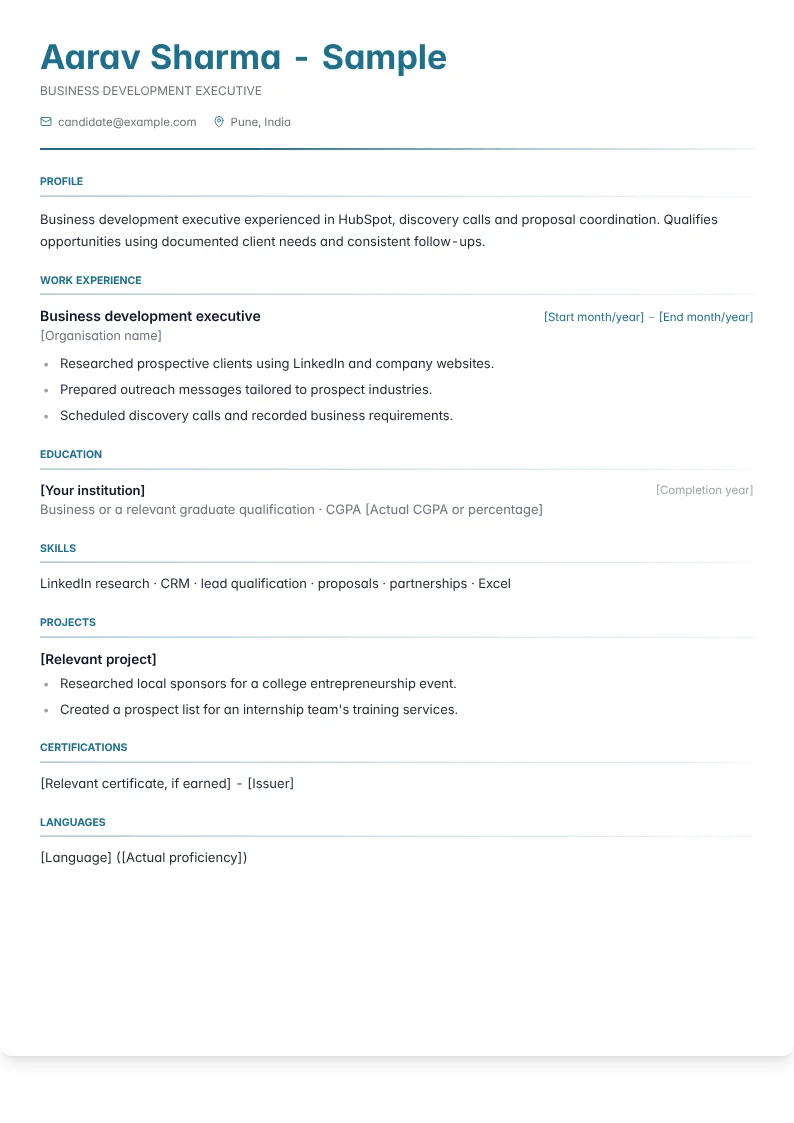
Aarav Sharma is fictional. Institution, organisation, grades and date fields are placeholders. Replace them with your real details. This is the Modern Clean layout.
Define the growth opportunity you worked on
Business development can mean outbound prospecting, channel partnerships, market entry, or parts of a direct sales cycle. Your resume should resolve that ambiguity immediately. Identify the offering, target organisations, and type of opportunity you helped create. Indian employers use this title across IT services, education, recruitment, manufacturing, and other sectors, often with very different expectations. Explain whether your work focused on finding suitable accounts, securing discovery conversations, developing partner relationships, or advancing proposals. Avoid presenting a title alone as evidence of strategic responsibility. Recruiters need to understand where your work started, what qualified an opportunity, and which colleague or team took responsibility when it moved beyond your remit.
Show the research behind your outreach
Good prospecting begins with a reason to approach a particular organisation. Describe how you identified relevant companies, understood their context, and selected appropriate contacts. Useful evidence might include account research, market mapping, event follow-up, or analysis of an existing customer profile. Explain how you adapted a message to a plausible business need rather than merely personalising a greeting. Recruiters assessing Indian outsourcing or services roles may probe the markets you contacted, the buyer functions you understood, and your ability to communicate across time zones. Be accurate about your exposure. Using a prospecting platform does not by itself demonstrate research quality, and collecting contact details is not the same as identifying genuine buying interest.
Explain qualification and the handover standard
A meeting becomes useful when the receiving team understands why it matters. Show how you explored the prospect's problem, current approach, decision process, and readiness for a further discussion. Do not imply that every interested reply became a qualified opportunity. Explain how you recorded context, flagged uncertainties, and agreed the next step with sales or delivery colleagues. If you contributed to proposals, distinguish gathering inputs, drafting sections, coordinating approvals, and negotiating terms. Indian recruiters may screen for written communication, CRM discipline, relevant market exposure, and willingness to work the advertised schedule. Keep shift availability truthful. Sustainable business development depends on accurate expectations, not promises made solely to obtain a meeting or accelerate a handover.
Demonstrate value without inflating pipeline
Choose a bullet that makes your judgement visible. Hypothetical rewrite: • Before: Generated leads through email and LinkedIn for business growth. • After: Researched manufacturers with fragmented service enquiries, tailored outreach around enquiry handling, and passed interested accounts to the sales lead with notes on their current process and requested next steps. The revision explains targeting, relevance, and handover quality without inventing a commercial result. If you report pipeline value, clarify whether it was identified, accepted, proposed, or contracted, using your employer's actual definitions. Never describe an unsigned proposal as revenue. A recruiter should be able to trace your contribution without assuming that you controlled pricing, delivery commitments, or the final purchasing decision.
Provide suitable samples for your career stage
A fresher can build a compact account research exercise, a reasoned prospect shortlist, and original outreach examples for a clearly fictional campaign. Explain the selection criteria and acknowledge assumptions instead of claiming the campaign produced customers. Experienced candidates should show how their judgement developed through rejected opportunities, revised targeting, or stronger partner qualification. A portfolio is optional, but concise, anonymised samples can help demonstrate writing and commercial thinking. Remove real personal contact information and confidential proposals. Relevant learning in negotiation, sales tools, or an industry can support your application; add a particular credential if the vacancy asks for it. Keep the emphasis on evidence that you understand a prospect's business rather than merely a platform's features.
Avoid shortcuts that confuse activity with opportunity
Common mistakes include presenting an unfiltered contact database as a pipeline, using identical outreach for unrelated buyers, claiming partnerships after an introductory conversation, and promising capabilities before checking with delivery teams. Each mistake raises a different concern about commercial judgement. Replace broad claims with a clear account of how you decided whom to pursue and when to stop. Before interviews, prepare an example of an account you deliberately disqualified and explain why that protected time or expectations. Also distinguish business development from closing if your role ended at qualification. In Indian hiring processes, be ready to clarify employment continuity, notice period, and overseas market exposure without exaggerating your responsibility for accounts handled jointly.
Arrange the evidence for this application
Identify target markets and opportunity stages first, followed by research, qualification and partnership experience. Keep outreach samples beside the relevant assignment. If entering the field, put a clearly fictional account-research exercise after education. Place platform skills later so a contact-finding tool does not become the main story instead of commercial judgement.
Key skills and tools
- LinkedIn research
- CRM
- lead qualification
- proposals
- partnerships
- Excel
Copy only statements that match your actual work. Replace bracketed metrics only with verified values, or remove the number. These suggested revisions are examples, not claims about a real candidate.
Fresher and project bullet examples
Researched local sponsors for a college entrepreneurship event.
Created a prospect list for an internship team's training services.
Drafted outreach emails under a business development mentor's review.
Compared local competitors for a student business plan project.
Recorded partnership call notes during a business development internship.
Prepared a campus sponsorship proposal with reviewed deliverables.
Experienced bullet examples
Researched prospective clients using LinkedIn and company websites.
Prepared outreach messages tailored to prospect industries.
Scheduled discovery calls and recorded business requirements.
Maintained prospect contact and qualification details in HubSpot.
Coordinated proposal inputs with sales and delivery teams.
Tracked follow-ups and pending client responses.
Improved qualified response rate by [X]% against the recorded baseline.
Reviewed market information from trade publications and company filings.
Researched [N] organisations for potential partnership opportunities.
Summarised discovery call outcomes and agreed next steps.
Prepared capability presentations for prospective business clients.
Mapped decision-makers and procurement steps for target accounts.
Three summary examples
Business development fresher with market research and campus sponsorship projects. Prepared prospect lists and clear outreach material using Excel and LinkedIn research.
Business development executive experienced in HubSpot, discovery calls and proposal coordination. Qualifies opportunities using documented client needs and consistent follow-ups.
Business development candidate with internship prospecting and previous work in another customer-facing field. Connects industry research with practical outreach and partnership documentation.
Frequently asked questions
How is business development different from sales?
The boundary varies by employer. Business development may focus on creating and qualifying opportunities, while sales may own negotiation and closing. Read the actual responsibilities rather than relying on the title.
What should a fresher include instead of client wins?
Use an original account research exercise and explain why particular companies might fit an offering. Label hypothetical outreach clearly and do not imply that it generated real business.
Should I list every prospecting tool I have tried?
No. Prioritise tools you can use confidently and explain how they supported research, outreach, or record keeping.
Can I include proposal values?
Only when disclosure is appropriate and the figures are accurate. Distinguish proposed value from contracted business and identify your contribution.