
Resume Ground resources
Business analyst resume example
A practical Indian business analyst resume format, with sample statements for freshers and experienced applicants.
The button opens the existing template and role-starter flow. Where no matching starter exists, start blank and copy suitable statements below.
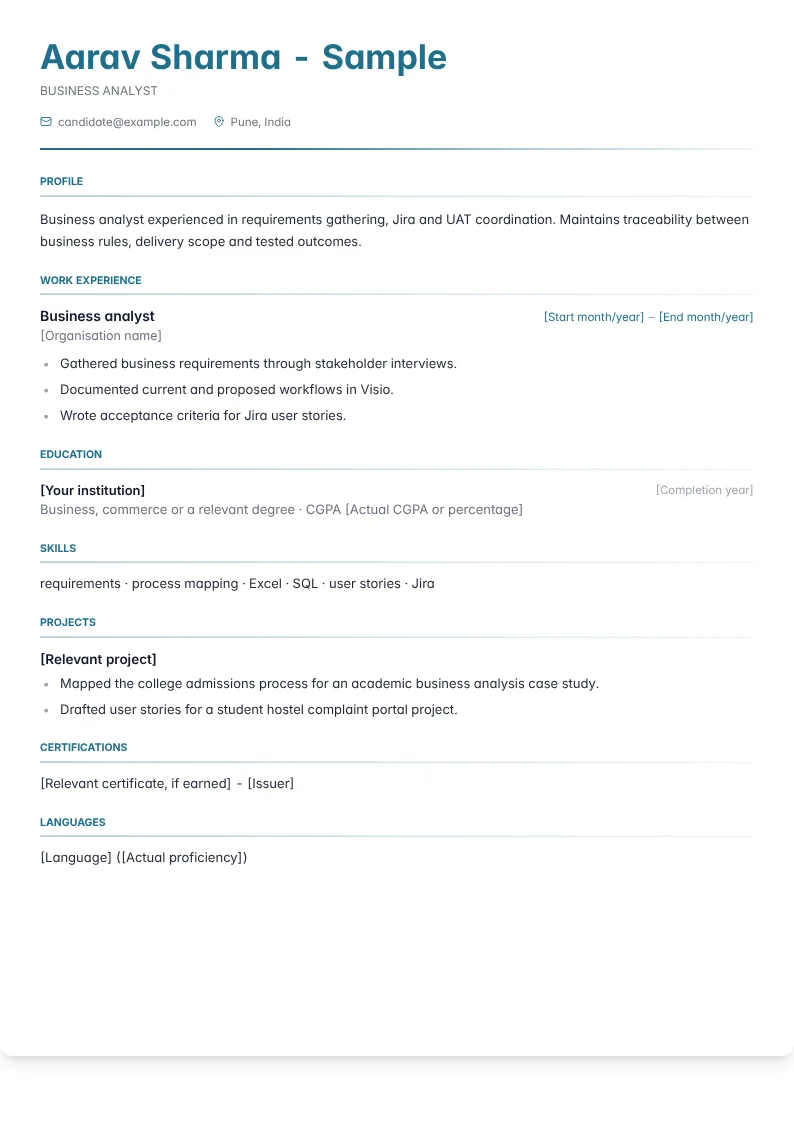
Sample resume, not a real candidate
Aarav Sharma is fictional. Institution, organisation, grades and date fields are placeholders. Replace them with your real details. This is the Modern Clean layout.
Lead with the business problem you helped clarify
A business analyst resume should make ambiguity visible, then show how you reduced it. Open with the business area you understand, the stakeholders you worked with, and the decisions your analysis supported. Indian recruiters may shortlist separately for IT business analysis, operations analysis, banking processes, or reporting roles, so identify your actual lane rather than presenting every analytical activity as equivalent. Describe whether you gathered requirements, examined workflows, investigated data discrepancies, or supported solution delivery. A useful summary connects these responsibilities to a recognisable setting, such as customer onboarding or order fulfilment. Avoid introducing yourself only as a liaison: explain what information you translated and what the receiving team needed from it.
Show how requirements became usable decisions
Your experience should reveal the path from stakeholder conversation to an agreed requirement. Explain how you identified participants, documented conflicting expectations, checked assumptions, and obtained clarification before development or process changes began. Mention user stories, acceptance criteria, process maps, or business requirements documents only where you actually created or maintained them. Recruiters reviewing Indian IT services applications often look for evidence that you can work with client stakeholders and delivery teams without confusing requests with approved scope. If you supported testing, distinguish writing scenarios, coordinating user acceptance testing, and fixing defects. These are different contributions. Show how unresolved questions were tracked so a hiring manager can picture your working method.
Make analytical tools and domain knowledge credible
Organise skills around the work they enable. SQL can support investigation, spreadsheets can reconcile operational records, and a visualisation tool can explain trends, but none proves business analysis capability by itself. Describe the questions you answered and the limitations you checked. Domain knowledge becomes convincing when attached to actual processes, terminology, or business rules rather than a broad industry label. Include a relevant course or certification as optional supporting evidence; add a particular credential if the vacancy asks for it. For portfolio material, use sanitised process diagrams, sample acceptance criteria, or a fictional requirements pack. Remove client names, internal commercial assumptions, customer records, and screenshots that expose restricted systems.
Build different evidence for freshers and experienced applicants
Freshers can demonstrate structured thinking through a college project, internship, or independently analysed service journey. Explain the original problem, who would use the proposed solution, and how you separated assumptions from verified information. A carefully bounded case study is more useful than pretending to have managed enterprise stakeholders. Experienced applicants should establish ownership boundaries: whether they led discovery, maintained a backlog, specialised in a process area, or supported a senior analyst. In India, application forms may also ask about notice period, location preferences, and client interaction. Keep those answers consistent with your resume and discuss shift expectations honestly. Do not disguise coordination work as decision authority you did not hold.
Replace activity lists with traceable contributions
Use bullets that connect a business uncertainty to an analytical action and a usable output. Concrete evidence need not contain a percentage or financial claim. Hypothetical rewrite: • Before: Responsible for gathering requirements and coordinating with developers. • After: Mapped the customer onboarding workflow, clarified exception rules with operations, and converted agreed requirements into user stories and acceptance criteria for the development team. The stronger version names the process, explains the analyst's intervention, and identifies the handover artefacts without inventing results. Apply this approach to your own work only where each element is true. If a project remains unfinished, describe the completed analysis rather than implying implementation, adoption, or benefits that have not yet been observed.
Remove the signals that create interview doubt
Four mistakes frequently weaken this resume. First, listing every diagramming and project tool without explaining its use makes the skills section difficult to trust. Second, describing yourself as the product owner when you only documented requests creates avoidable questions about authority. Third, mixing business intelligence reporting with requirements analysis without explaining the connection obscures your fit. Fourth, sharing client artefacts to prove experience can raise confidentiality concerns. Before applying, compare your language with the vacancy's actual deliverables and prepare an example of a disputed requirement, a missed assumption, and a change request. Recruiters need to understand not merely which documents you produced, but how your judgement helped teams agree on what to build.
Arrange the evidence for this application
Lead with your business process specialism, then relevant analysis assignments and the requirements artefacts you produced. Locate domain and tool skills after those examples. An entry-level applicant can put education and an original process case first. Avoid placing generic coordination duties above a requirement you clarified, since that makes the target function harder to identify.
Key skills and tools
- requirements
- process mapping
- Excel
- SQL
- user stories
- Jira
Copy only statements that match your actual work. Replace bracketed metrics only with verified values, or remove the number. These suggested revisions are examples, not claims about a real candidate.
Fresher and project bullet examples
Mapped the college admissions process for an academic business analysis case study.
Drafted user stories for a student hostel complaint portal project.
Recorded UAT feedback for an internship team's invoicing application.
Created an Excel requirements tracker during a business analyst internship.
Interviewed student volunteers to identify gaps in event registration.
Prepared an as-is and to-be flow for a college library lending project.
Experienced bullet examples
Gathered business requirements through stakeholder interviews.
Documented current and proposed workflows in Visio.
Wrote acceptance criteria for Jira user stories.
Mapped process handoffs and identified missing approvals.
Clarified requirements with business owners and developers.
Supported UAT with test scenarios and issue trackers.
Reduced process turnaround time by [X]% through agreed workflow changes.
Tracked requirement changes and their effect on delivery scope.
Prepared [N] process diagrams for stakeholder review.
Summarised decisions and open questions in meeting notes.
Maintained a requirements traceability matrix through release sign-off.
Compared solution options against business rules and operational constraints.
Three summary examples
Business analysis fresher with project work in process mapping, Excel and user stories. Translated student and stakeholder needs into acceptance criteria and workflow diagrams.
Business analyst experienced in requirements gathering, Jira and UAT coordination. Maintains traceability between business rules, delivery scope and tested outcomes.
Business analysis candidate with internship documentation and prior work in customer-facing operations. Brings domain knowledge to stakeholder interviews, process diagrams and clear acceptance criteria.
Frequently asked questions
Is SQL compulsory for business analyst jobs?
It depends on the role. Data-heavy vacancies may assess SQL, while process-focused positions may prioritise requirements and stakeholder work. Include SQL if you can explain queries you have used; develop it further if the vacancy asks for it.
Can I apply without a business analyst job title?
Yes. Show relevant requirements, workflow, investigation, or testing responsibilities under your actual title. Explain the transition without renaming your previous position.
What can I show when client work is confidential?
Create a clearly labelled fictional case with an original process map, sample requirements, and acceptance criteria. Do not reproduce protected client material.
Should I include a business analysis certification?
Include a relevant certification as optional evidence of learning, especially when experience is limited. It should support, not replace, examples of analytical work.