
Resume Ground resources
Graphic designer resume example
A practical Indian graphic designer resume format, with sample statements for freshers and experienced applicants.
The button opens the existing template and role-starter flow. Where no matching starter exists, start blank and copy suitable statements below.
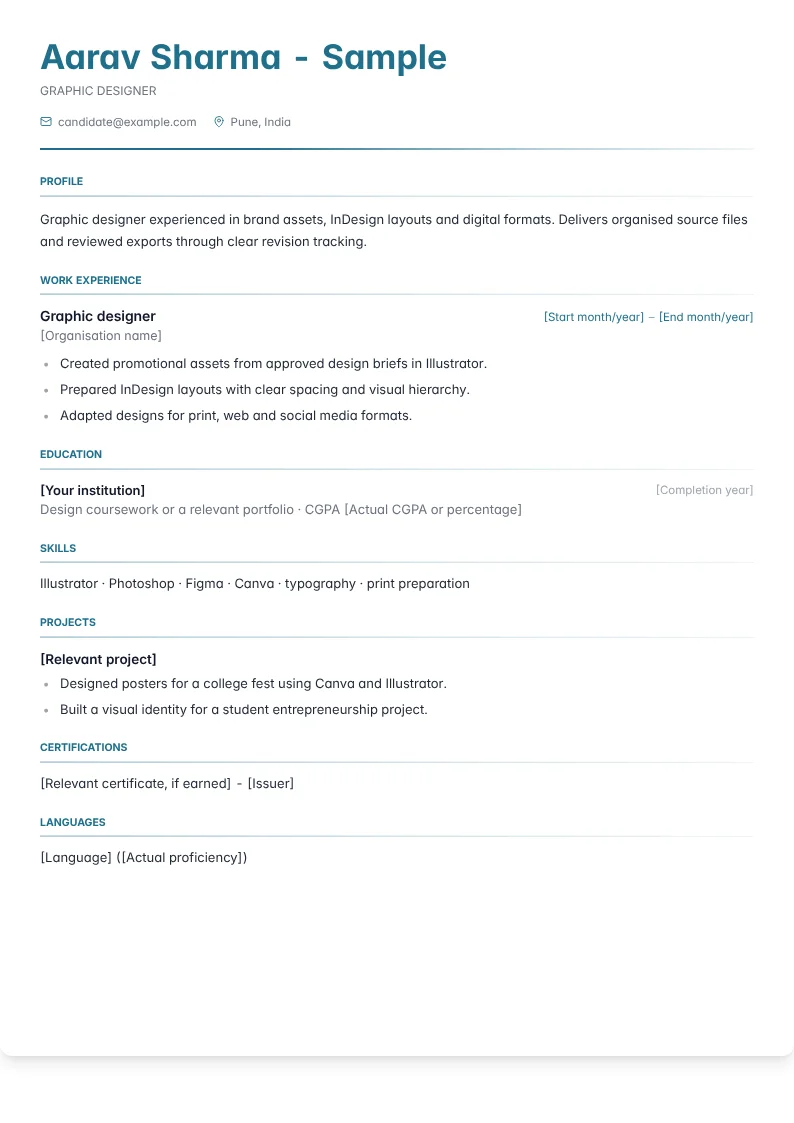
Sample resume, not a real candidate
Aarav Sharma is fictional. Institution, organisation, grades and date fields are placeholders. Replace them with your real details. This is the Modern Clean layout.
Make the portfolio easy to assess first
A graphic designer's application should lead a reviewer to relevant visual work with minimal friction. Put an accessible portfolio link near your contact information and arrange projects around the work the vacancy actually involves. Indian employers may hire separately for brand communication, social creatives, packaging, print production, or presentation design, even when the advertised title is broad. Show the strongest matching projects early rather than organising everything chronologically. Each project needs enough context to explain the audience, brief, and your contribution. If you collaborated with a copywriter, photographer, or senior designer, acknowledge that division. Recruiters should not have to guess which parts demonstrate your own design decisions and which arrived as supplied assets.
Explain the brief and your visual reasoning
A polished mockup can attract attention, but a short account of the design problem helps establish judgement. Explain what the communication needed to achieve, where it would appear, and which constraints shaped your approach. Discuss hierarchy, typography, imagery, colour, or layout only where the choice served the brief. Showing an alternative direction can be useful if you explain why it was rejected, rather than filling the portfolio with unexplained variations. Indian hiring teams may assess whether you can work within an existing identity as well as create new visual directions. Demonstrate adaptation across formats without implying that resizing alone is the same as designing an effective communication for a different viewing context.
Prove that your files can reach production
Design roles often require dependable delivery as well as visual ideas. Describe your experience preparing editable files, organising assets, checking image suitability, or coordinating specifications with printers and other production partners. For digital work, explain relevant export formats, layout variations, and handover practices. Avoid treating software proficiency as proof that you understand production. Recruiters may ask about print preparation, brand consistency, and handling revisions under a real brief. Answer from actual experience, and identify where a senior colleague performed the final checks. Stock assets, typefaces, and images also need appropriate usage permissions. Show awareness of those practical constraints without presenting yourself as a legal specialist or claiming that every asset found online is available for commercial use.
Use a bullet that reveals design decisions
Replace vague creative claims with an example of how you solved a communication problem. Hypothetical rewrite: • Before: Created attractive posters and social media designs for campaigns. • After: Developed a workshop promotion layout that prioritised the session topic and registration action, then adapted the hierarchy for a printed poster and mobile social placement. This version identifies the message, visual priority, and adaptation without inventing engagement results. Pair the bullet with the actual work when sharing is permitted. If the project was self-initiated, label it as a concept and state the brief you created. Do not place a familiar company's logo on speculative work in a way that implies a client relationship that never existed.
Choose evidence appropriate to your experience
Freshers can demonstrate readiness through original identity studies, editorial layouts, campaign systems, or supervised internship projects. A small, coherent selection with visible reasoning is more useful than a crowded gallery of tutorials. Experienced designers should show how they handled constraints, maintained consistency, collaborated with stakeholders, or guided production across related assets. Clarify whether you developed the concept or executed an established direction. Formal design education and software credentials can be optional supporting evidence; include a particular qualification if the vacancy asks for it. Indian recruiters may request a practical assignment, so confirm the brief, expected deliverables, and permitted use. Be honest about which tools you can operate independently and which you are still learning.
Remove portfolio choices that weaken confidence
Four mistakes commonly create doubt: presenting copied tutorial work as original thinking, relying entirely on mockups that conceal the actual layout, including confidential or unapproved client material, and claiming equal proficiency across every design discipline. Fix these issues before adding more projects. Show flat artwork or readable details where necessary, test portfolio access on a phone, and check that captions match the work displayed. Your resume should remain legible and easy to scan even if your portfolio is expressive. For Indian applications, state location flexibility and notice period where relevant, but do not crowd the page with personal details. Let the work, the explanation, and the quality of the handover establish professional readiness.
Arrange the evidence for this application
Make the portfolio address the first usable link, followed by a concise design specialism and recent briefs. Keep production skills separate from conceptual responsibilities. Freshers can show self-initiated projects before internships when those projects demonstrate stronger reasoning. Put software training below the work selection, and avoid a decorative resume layout that makes the portfolio address difficult to read.
Key skills and tools
- Illustrator
- Photoshop
- Figma
- Canva
- typography
- print preparation
Copy only statements that match your actual work. Replace bracketed metrics only with verified values, or remove the number. These suggested revisions are examples, not claims about a real candidate.
Fresher and project bullet examples
Designed posters for a college fest using Canva and Illustrator.
Built a visual identity for a student entrepreneurship project.
Prepared print-ready flyers during a graphic design internship.
Created an illustrated infographic for an academic communication assignment.
Organised Photoshop layers and source files under an internship designer's review.
Published a portfolio of logo, layout and social media design projects.
Experienced bullet examples
Created promotional assets from approved design briefs in Illustrator.
Prepared InDesign layouts with clear spacing and visual hierarchy.
Adapted designs for print, web and social media formats.
Reviewed typography and colours against brand guidelines.
Organised editable source files for designer handovers.
Incorporated client feedback and recorded design revisions.
Reduced asset preparation time by [X]% through reusable layout systems.
Checked print bleed, export dimensions and colour settings before delivery.
Prepared [N] design concepts for stakeholder review.
Coordinated image and copy requirements with content teams.
Retouched product photographs in Photoshop without altering product details.
Created Figma components for consistent presentation layouts.
Three summary examples
Graphic design fresher with Illustrator, Photoshop and college poster projects. Prepared portfolio work showing layout, typography and print-ready exports.
Graphic designer experienced in brand assets, InDesign layouts and digital formats. Delivers organised source files and reviewed exports through clear revision tracking.
Design candidate with a studio internship and prior work in another creative field. Translates communication goals into Figma layouts, promotional artwork and consistent visual systems.
Frequently asked questions
Do I need a design degree?
Not every employer requires one. A degree can provide useful context, but the portfolio should demonstrate relevant ability. Include a specific qualification if the vacancy asks for it.
Can personal projects go into my portfolio?
Yes. Label them as self-initiated or conceptual, explain the brief, and show your original decisions. Do not imply endorsement by a real brand.
Should my resume be highly decorative?
Prioritise readability and clear links. A restrained resume can work well when a separate portfolio carries the detailed visual evidence.
How should I show collaborative work?
Name your responsibilities and credit the other contributions. A clear account of teamwork is more credible than claiming the entire project.