
Resume Ground resources
DevOps engineer resume example
A practical Indian devops engineer resume format, with sample statements for freshers and experienced applicants.
The button opens the existing template and role-starter flow. Where no matching starter exists, start blank and copy suitable statements below.
Sample resume, not a real candidate
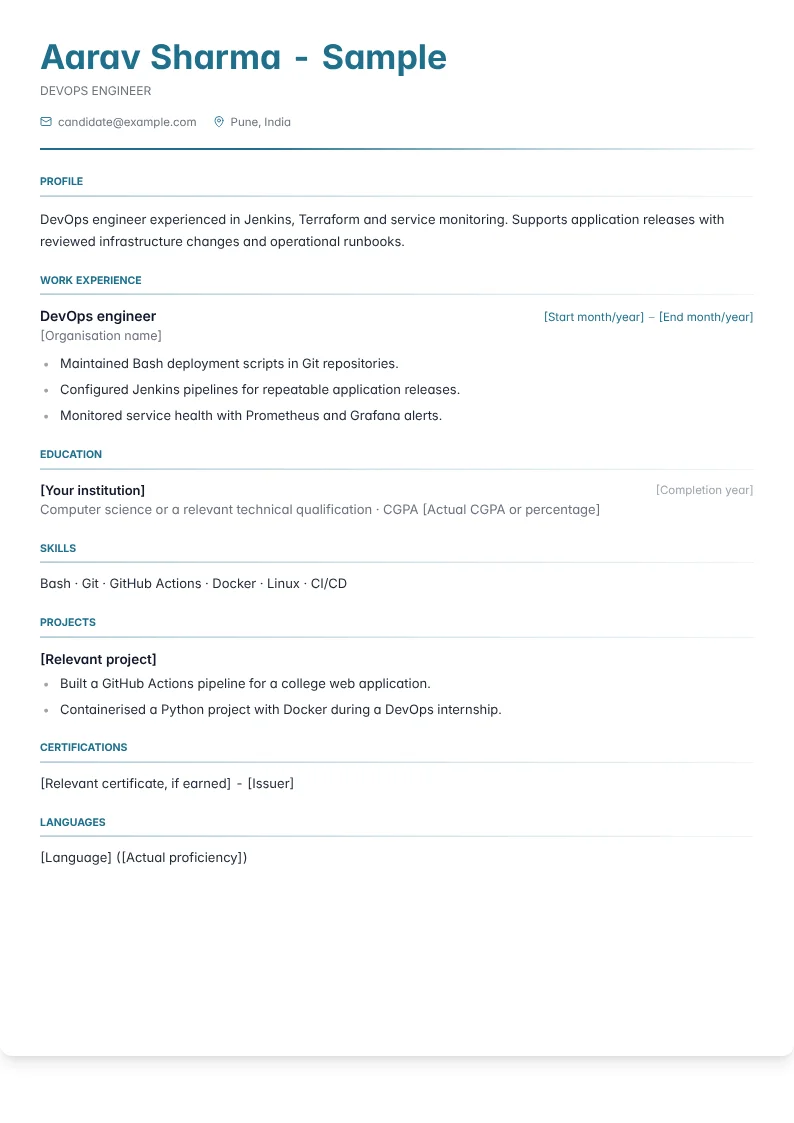
Aarav Sharma is fictional. Institution, organisation, grades and date fields are placeholders. Replace them with your real details. This is the Modern Clean layout.
Open with operational responsibility
A DevOps engineer application should clarify what you helped build, release, operate, or recover. The title can cover different combinations of infrastructure, delivery automation, platform support, and reliability work. Recruiters in India may screen for a cloud platform, Linux, scripting, infrastructure as code, containers, and pipeline tooling, but a list alone does not establish operational competence. State the environments you worked with and the limits of your access or ownership. Distinguish assisting a deployment from designing the release process. If support duties were part of the role, describe the service context and escalation responsibilities accurately. The aim is to show how your work made software delivery more controlled and systems easier to understand.
Demonstrate safe change and recoverability
Organise examples around changes that required care: modifying infrastructure, introducing a deployment stage, rotating credentials, or investigating a failing service. Explain the checks before execution, the signals observed afterwards, and the recovery path if the change behaved unexpectedly. Infrastructure as code experience should include how changes were reviewed and how environment differences were managed. Monitoring deserves more detail than naming a dashboard tool; identify what a signal indicated and how it informed action. Where you participated in an incident, separate detection, mitigation, recovery, and follow up. You do not need to claim sole responsibility for availability. A precise account of your part in a coordinated response is more useful than a broad reliability slogan.
Remove risky signals from your evidence
Four mistakes can quickly undermine an operational profile. Publishing access keys or internal configuration demonstrates unsafe handling of sensitive information. Claiming production ownership after only completing a local tutorial exaggerates experience. Describing a pipeline as fully automated while omitting manual approvals obscures how delivery actually worked. Claiming uninterrupted availability without defensible records invites questions you may be unable to answer. Correct these problems through sanitised examples, clear environment labels, honest process descriptions, and bounded claims. Review repositories for secrets before sharing them, including their visible history. Explain permission choices and rollback assumptions where relevant. An attractive architecture diagram cannot compensate for uncertainty about who could change the system or how a failed change would be reversed.
Make a delivery bullet operationally meaningful
Consider this hypothetical revision of a pipeline responsibility. • Before: Managed CI/CD pipelines and deployed applications to the cloud. • After: Added build validation and environment specific configuration checks to the deployment pipeline, with a documented rollback path and approval step before production release. The stronger bullet describes controls rather than implying that automation alone made delivery safe. It contains no invented speed or reliability result. Keep only the steps you actually implemented, and name the platform elsewhere if it helps screening. If the rollback procedure was tested in a nonproduction environment, say so when discussing it. Be ready to explain what the checks could detect, what they could miss, and who retained authority to approve the release.
Match projects and credentials to experience
Freshers can demonstrate fundamentals with a reproducible lab that builds an application, provisions a modest environment, and documents teardown and recovery. Label it as a lab rather than implying real customer traffic. Experienced applicants should prioritise change management, platform adoption, incident learning, and collaboration with application teams. A portfolio may include sanitised pipeline definitions, infrastructure modules, runbooks, or a carefully bounded architecture explanation. Public cloud certifications can support a claim of structured study, but they do not establish production judgement; submit a specific credential if the vacancy asks for it. Avoid leaving chargeable resources running for a demonstration. Explain cost awareness qualitatively through resource choices and cleanup practices without inventing savings or implying authority over budgets you did not manage.
Prepare for practical infrastructure discussions
Indian hiring conversations may separate recruiter checks on tool alignment from technical questioning about troubleshooting and operational judgement. Keep your notice period, location constraints, and willingness to cover the advertised support arrangement accurate. Do not imply that all DevOps roles involve the same shift or on call expectations; clarify the vacancy's arrangement directly. For technical preparation, practise investigating a failed deployment from logs, process state, network access, configuration, and permissions. Explain the order of your checks and how you avoid making the situation worse. Experienced candidates should discuss a tradeoff involving developer convenience and operational control. Freshers can demonstrate the same caution in a lab by documenting failure injection, recovery steps, and what they still cannot confidently diagnose.
Arrange the evidence for this application
After the infrastructure and delivery summary, order experience around environments, release work and operational response. Separate lab projects from production responsibilities. A graduate can place a reproducible deployment lab directly after education, with setup and recovery notes together. Put cloud course credentials below practical examples unless the vacancy gives them particular prominence.
Key skills and tools
- Bash
- Git
- GitHub Actions
- Docker
- Linux
- CI/CD
Copy only statements that match your actual work. Replace bracketed metrics only with verified values, or remove the number. These suggested revisions are examples, not claims about a real candidate.
Fresher and project bullet examples
Built a GitHub Actions pipeline for a college web application.
Containerised a Python project with Docker during a DevOps internship.
Configured a Linux virtual machine for an academic networking lab.
Created Grafana dashboards for a local practice service.
Tested Terraform plans in a sandbox under an internship mentor's review.
Documented a rollback exercise for a portfolio deployment pipeline.
Experienced bullet examples
Maintained Bash deployment scripts in Git repositories.
Configured Jenkins pipelines for repeatable application releases.
Monitored service health with Prometheus and Grafana alerts.
Investigated failed deployments and recorded root causes.
Managed environment configuration through approved secret stores.
Tested backup restoration in a non-production environment.
Reduced deployment time by [X]% through pipeline caching changes.
Documented operational runbooks and rollback procedures.
Reviewed [N] infrastructure changes before deployment.
Resolved build failures with application developers.
Containerised services with Docker and documented image build steps.
Provisioned reviewed AWS infrastructure changes using Terraform.
Three summary examples
DevOps fresher with Linux, Docker and CI pipeline projects. Practised repeatable builds and rollback checks in local or sandbox environments.
DevOps engineer experienced in Jenkins, Terraform and service monitoring. Supports application releases with reviewed infrastructure changes and operational runbooks.
Cloud operations candidate with DevOps internship exposure and a previous background in IT support. Applies Linux troubleshooting to build pipelines, Docker services and monitored deployments.
Frequently asked questions
Do I need experience with every major cloud?
No. Strong evidence on the platform relevant to the vacancy is more useful than shallow claims across several providers.
Can a home lab support a DevOps application?
Yes, when labelled honestly. Show reproducible setup, safe configuration, troubleshooting notes, and cleanup rather than presenting the lab as production operations.
Should I put on call availability on my resume?
Discuss it when relevant to the vacancy. Confirm the actual support arrangement before committing, rather than assuming the title defines it.
How can I share incident experience safely?
Explain the failure class, your actions, and the learning without exposing internal addresses, customer details, credentials, or sensitive operational weaknesses.