
Resume Ground resources
Data scientist resume example
A practical Indian data scientist resume format, with sample statements for freshers and experienced applicants.
The button opens the existing template and role-starter flow. Where no matching starter exists, start blank and copy suitable statements below.
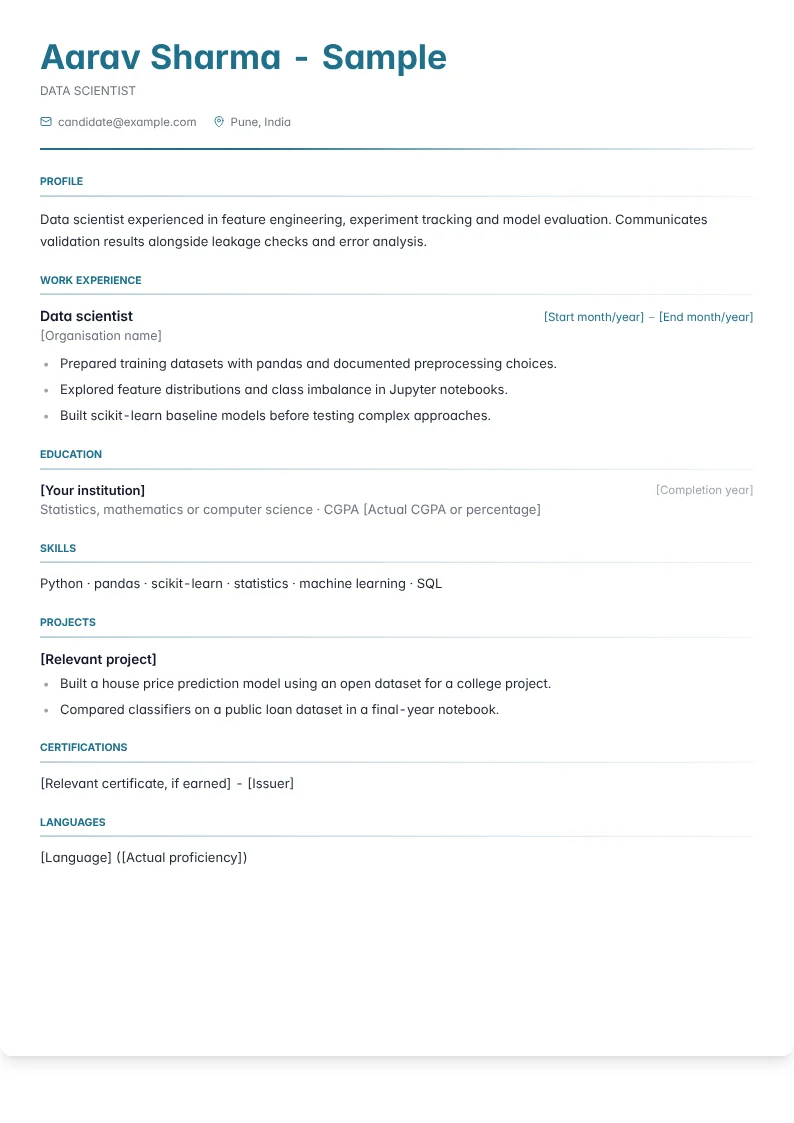
Sample resume, not a real candidate
Aarav Sharma is fictional. Institution, organisation, grades and date fields are placeholders. Replace them with your real details. This is the Modern Clean layout.
Establish the prediction or inference problem
A data scientist profile should explain what uncertainty you worked on and why modelling was appropriate. Start with the target, the intended use, and the consequences of an incorrect result. Recruiters in India may search for Python, SQL, statistical learning, and experience relevant to the employer's modelling needs. A technical reviewer will look beyond model names to problem formulation and evaluation judgement. Clarify whether your work involved forecasting, classification, experimentation, recommendation, or another method. Do not collapse exploratory analysis, model development, and deployed decision systems into a single claim. A precise description of the question gives readers a foundation for assessing the rest of your work and understanding where your contribution began.
Put evaluation choices before algorithm variety
Explain how you created a meaningful baseline and why the evaluation setup resembled the intended use. Discuss temporal ordering, grouped observations, class imbalance, or label quality where relevant to your project. A model comparison is not convincing if information from the eventual outcome leaked into its inputs. Describe why your chosen metric represented the cost of mistakes, and acknowledge what it did not capture. If you tuned a model, distinguish that process from the final evaluation. For deployed work, identify how predictions reached users and how changing data or delayed labels complicated monitoring. The strongest account makes your experimental reasoning inspectable rather than relying on an impressive collection of algorithms or a single favourable score.
Present a hypothetical modelling bullet honestly
This hypothetical rewrite adds scientific judgement without inventing a performance result. • Before: Built a machine learning model to predict customer churn. • After: Framed churn prediction around a defined observation window, compared a regularised baseline with a tree based model, and evaluated errors using a time ordered holdout. The revised bullet gives the interviewer concrete choices to examine. It does not claim that the model prevented churn or entered production. Use only the methodological details that match your work. If you later analysed which customers were missed or whether the inputs would be available at prediction time, discuss that separately. A defensible modelling narrative explains what was tested, what remained uncertain, and what additional evidence would be needed before operational use.
Build evidence appropriate to your career stage
Freshers benefit from a reproducible study with a clear question, documented data preparation, a baseline, and an honest error analysis. A carefully explained conventional method can demonstrate more maturity than an elaborate architecture selected for appearance. Experienced applicants should distinguish research exploration from production ownership and explain collaboration with engineers, analysts, or domain specialists. A portfolio may include an executable notebook, a structured repository, and a concise model report describing limitations. Avoid sharing personal data, proprietary features, or restricted training material. Degrees, research papers, and certificates can provide optional evidence of preparation; submit a specific credential if the vacancy asks for it. Explain your own contribution to joint research instead of relying on an institution's or collaborator's reputation.
Remove four signs of weak experimental practice
Four mistakes deserve particular attention. Randomly splitting time dependent records can produce an unrealistic evaluation. Reporting only accuracy can hide a model's failure on the cases that matter. Describing a notebook as a production system confuses experimentation with operational delivery. Claiming business improvement from offline model performance skips the evidence connecting prediction to action. Correct these problems by documenting the split logic, choosing relevant evaluation views, labelling project maturity accurately, and separating technical findings from commercial outcomes. Revisit feature availability as well: a field present in a historical extract may not exist when a prediction must be made. Candid discussion of such constraints demonstrates practical judgement rather than diminishing the sophistication of your work.
Navigate different data science vacancies
Read Indian job descriptions closely because the same title may refer to statistical analysis, applied modelling, experimentation, or engineering heavy delivery. Reorder your evidence around the actual work instead of applying an identical research narrative everywhere. Be explicit about SQL use, coding responsibilities, deployment participation, and domain familiarity. Recruiter discussions may also cover location, joining availability, and the distinction between academic and professional projects. For technical interviews, practise defending the problem definition before explaining the algorithm. Be ready to propose a simpler baseline, identify a leakage risk, and discuss a failed experiment. Experienced candidates should describe decisions made under operational constraints; freshers should show that they recognise those constraints even when their project did not encounter them directly.
Arrange the evidence for this application
Bring the modelling problem and evaluation approach into the opening profile. Follow with professional modelling work or, for a graduate, a reproducible research project after education. Separate publications from commercial deployments and place methods alongside their studies. Courses can follow the project evidence; a badge should not displace discussion of validation and error analysis.
Key skills and tools
- Python
- pandas
- scikit-learn
- statistics
- machine learning
- SQL
Copy only statements that match your actual work. Replace bracketed metrics only with verified values, or remove the number. These suggested revisions are examples, not claims about a real candidate.
Fresher and project bullet examples
Built a house price prediction model using an open dataset for a college project.
Compared classifiers on a public loan dataset in a final-year notebook.
Cleaned labelled text samples during a machine learning internship.
Created a Hindi sentiment analysis prototype and documented language limitations.
Tested a crop classification model with a held-out set for an academic study.
Presented a reproducible scikit-learn notebook with evaluation charts at a project review.
Experienced bullet examples
Prepared training datasets with pandas and documented preprocessing choices.
Explored feature distributions and class imbalance in Jupyter notebooks.
Built scikit-learn baseline models before testing complex approaches.
Evaluated models using cross-validation and task-appropriate metrics.
Compared model predictions with the agreed statistical baseline.
Documented feature engineering and reproducible environment setup.
Improved the selected validation metric by [X]% against the baseline.
Checked datasets for target leakage and sampling bias.
Ran [N] model experiments and logged their parameters and results.
Presented model findings with limitations and error examples.
Created reusable Python pipelines for preprocessing and inference.
Reviewed false-positive cases with domain stakeholders before model changes.
Three summary examples
Data science fresher with Python, pandas and scikit-learn academic projects. Evaluated baseline models with held-out data and documented preprocessing decisions.
Data scientist experienced in feature engineering, experiment tracking and model evaluation. Communicates validation results alongside leakage checks and error analysis.
Machine learning candidate with internship dataset preparation and a background in another analytical field. Uses Python notebooks and statistical reasoning to turn domain questions into testable models.
Frequently asked questions
Do I need deep learning projects?
Only when they fit the vacancy and problem. A rigorous statistical or conventional machine learning project can provide stronger evidence than an unsuitable complex model.
Can competitions support my application?
Yes, if you explain validation choices and your own work. Also distinguish competition conditions from the constraints of a real operating environment.
Should I report model scores?
Report genuine results with the metric, evaluation setup, and relevant limitations. Never invent a score or omit context that changes its meaning.
How should I describe deployment exposure?
Specify whether you packaged a model, built an endpoint, assisted integration, or monitored predictions. These are different responsibilities and should remain distinct.