
Data engineer resume example
A practical Indian data engineer resume format, with sample statements for freshers and experienced applicants.
The button opens the existing template and role-starter flow. Where no matching starter exists, start blank and copy suitable statements below.
Sample resume, not a real candidate
Aarav Sharma is fictional. Institution, organisation, grades and date fields are placeholders. Replace them with your real details. This is the Modern Clean layout.
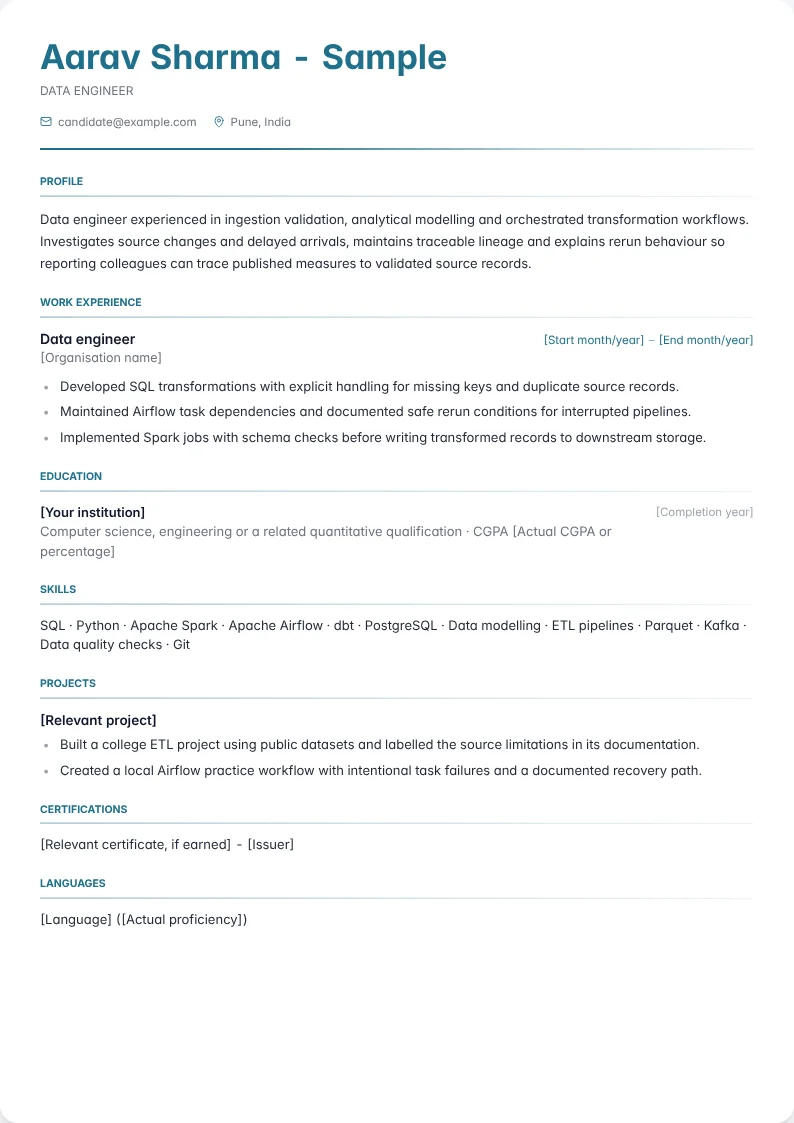
Target the data workflow in the vacancy
Data engineer, ETL developer, data integration engineer and junior data engineer are relevant Indian search titles. Check whether the listing centres on warehouse modelling, batch ingestion or streaming. Recruiters may look first for SQL, Python and the platform used to move and transform records. Name a source, processing step and consumer beside your opening experience. For an ETL vacancy, lead with ingestion and validation; for analytical modelling, lead with table grain and relationships. A graduate can choose a public-data pipeline with a reproducible output. Read degree and joining requirements in the notice, then prioritise a workflow whose tools and processing responsibilities match the advertised function.
Lead with a source-to-output pipeline
Present a project that reads source records, transforms them and produces a defined analytical table or file. Explain the input format, model grain and rules applied to keys and duplicates. Include a lineage diagram showing where fields come from and how the output is used. Python can demonstrate ingestion validation, SQL the transformation and Airflow the dependency order. A Spark assignment can show partition choices and schema handling through a repeatable job. Put an internship pipeline ahead of unrelated reporting coursework when its tasks fit the listing. Experienced applicants can prioritise maintained transformations and source changes, while senior engineers can show contract reviews and coordination with downstream consumers.
Practise SQL, modelling and recovery questions
Technical rounds may ask for joins, window functions, deduplication and the effect of missing keys. Use a query from your model to explain the expected result and how you checked it. Describe how dbt source tests or fixtures validate relationships and accepted values. For Airflow, prepare the dependency graph and explain what a rerun replaces or appends. A Kafka example can discuss repeated messages and the consumer's handling of them. Spark reasoning can cover partitions, data types and the point at which schema checks run. Keep a failed workflow ready for discussion, with the recovery step and validation that established whether the resulting output was suitable for its consumer.
Present technical education and pipeline preparation
A graduate data engineering application can connect a computing or quantitative degree to the model built during study. State the university, branch and passing or expected completion year. Copy official marks into the requested percentage or CGPA field, including the grading scale; any conversion must follow the institution's documented formula. Use relevant database or distributed-processing subjects to explain table grain, partitioning and transformation choices. An internship row can identify the ingestion job, acceptance test or source mapping delivered. Place a warehouse capstone where its lineage is easy to inspect. Analysts moving into engineering can show completed orchestration and recurring loads beside earlier reports, making the progression from analytical output to pipeline implementation understandable.
Choose a provider credential for the intended stack
AWS Certified Data Engineer - Associate and Google Cloud Professional Data Engineer are identifiable provider-specific certifications. Keep the exact earned designation and award date, and check current issuer requirements before planning an assessment. Select preparation according to the vacancy's storage, orchestration and transformation environment. Pair the credential with a model or pipeline that demonstrates the reasoning behind the platform choices. Databricks workshops and training can be listed as completed learning under their actual titles; distinguish them from an assessed credential. A practical project can explain acceptance checks, dependencies and recovered output alongside the certification. This combination gives an interviewer something concrete to inspect beyond the provider name and examination preparation.
Make the pipeline walkthrough reproducible
Keep source ownership and your processing contribution accurate; use permitted public data or sample fixtures instead of private extracts and credentials. Before applying, run the workflow from installation through output validation and check the repository permissions. Provide a small input, the transformation command and a way to inspect rejected records. Explain a source-schema change and the downstream field it affected. For support-oriented vacancies, prepare a handover describing the failed task, recovery action and next check. Keep joining details separate from the workflow. A clear source-to-consumer walkthrough helps the interviewer assess SQL reasoning, modelling and operational preparation using the same project shown on the resume.
Key skills and tools
- SQL
- Python
- Apache Spark
- Apache Airflow
- dbt
- PostgreSQL
- Data modelling
- ETL pipelines
- Parquet
- Kafka
- Data quality checks
- Git
Soft skills
- Data stewardship
- Incident communication
- Analytical questioning
- Cross-team coordination
- Documentation discipline
- Careful prioritisation
Copy only statements that match your actual work. Replace bracketed metrics only with verified values, or remove the number. These suggested revisions are examples, not claims about a real candidate.
Fresher and project bullet examples
Built a college ETL project using public datasets and labelled the source limitations in its documentation.
Created a local Airflow practice workflow with intentional task failures and a documented recovery path.
Tested a student data warehouse model with sample records covering absent and duplicated identifiers.
Developed a Spark coursework job that compared partition choices using reproducible sample inputs.
Presented a data engineering project with lineage diagrams and clearly defined transformation rules.
Experienced bullet examples
Developed SQL transformations with explicit handling for missing keys and duplicate source records.
Maintained Airflow task dependencies and documented safe rerun conditions for interrupted pipelines.
Implemented Spark jobs with schema checks before writing transformed records to downstream storage.
Created dbt models with source tests and clearly documented relationships between analytical tables.
Investigated delayed data arrivals and recorded their effect on downstream reporting assumptions.
Reviewed Kafka consumer behaviour for repeated messages and documented the chosen deduplication approach.
Wrote Python ingestion checks that separated malformed rows from accepted records for investigation.
Documented data lineage from source fields through transformations to the published analytical output.
Resolved [N] pipeline defects using test input fixtures and targeted validation of recovered outputs.
Coordinated source-schema changes with reporting colleagues before modifying shared transformation logic.
Three summary examples
Engineering graduate with ETL projects using SQL transformations, Python validation and warehouse test fixtures. Built Spark coursework jobs and Airflow workflows with lineage diagrams, source checks and recovery notes, seeking a graduate data engineer role.
Data engineer experienced in ingestion validation, analytical modelling and orchestrated transformation workflows. Investigates source changes and delayed arrivals, maintains traceable lineage and explains rerun behaviour so reporting colleagues can trace published measures to validated source records.
Senior data engineer responsible for reviewing pipeline contracts, modelling conventions and recovery plans across shared data workflows. Guides source-change coordination and data stewardship while helping teams reason about duplicates, delayed events and validation failures in published analytical outputs.