
Cybersecurity analyst resume example
A practical Indian cybersecurity analyst resume format, with sample statements for freshers and experienced applicants.
The button opens the existing template and role-starter flow. Where no matching starter exists, start blank and copy suitable statements below.
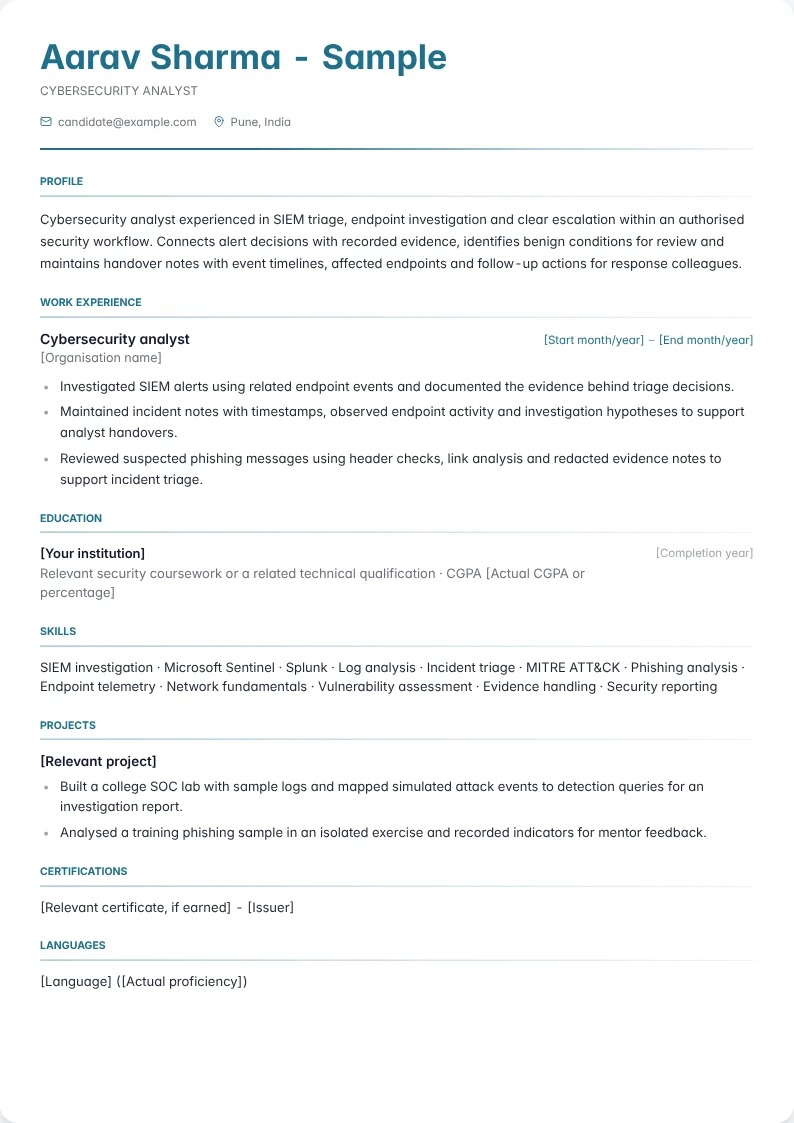
Sample resume, not a real candidate
Aarav Sharma is fictional. Institution, organisation, grades and date fields are placeholders. Replace them with your real details. This is the Modern Clean layout.
Target the security function named in the listing
Cybersecurity analyst, SOC analyst, security operations analyst and junior information security analyst vacancies in India can focus on monitoring, investigations or vulnerability review. Read the duties and select the function matching your preparation. A SOC recruiter may first inspect SIEM queries, network fundamentals and alert triage; a vulnerability team may prioritise validation and reporting. Put the investigation setting beside the summary and identify the tool used. A graduate can lead with an isolated log-analysis lab, while an experienced analyst can begin with assigned investigations and handovers. Check the notice for shift arrangements, technical qualifications and any required credential so the opening evidence fits the actual security desk.
Lead with an investigation report or SOC lab
Choose a simulated event sequence that lets you explain a detection query, supporting logs and triage decision. State the question investigated and show the timeline of relevant endpoint or network activity. A phishing exercise can include header inspection and indicators recorded for review. MITRE ATT&CK mapping can connect observed behaviour to the technique discussed in the report. Provide sample logs and the query needed to reproduce a match. A supervised internship can lead when it includes a completed investigation task. Experienced analysts can prioritise incident notes and detection feedback, while senior applicants can add review practices that helped colleagues evaluate evidence and prepare a response handover.
Prepare the alert reasoning for a technical round
Practise explaining why an alert needed escalation, closure or another check. Technical interviewers may ask about benign explanations, missing telemetry and the relationship between endpoint and network signals. Use an investigation you know to separate the observed event from the hypothesis. A Splunk or Microsoft Sentinel query can demonstrate filters, timestamps and how you examined related activity. Review network fundamentals relevant to the logs, including DNS and connection context. For vulnerability findings, explain the affected component, validation performed and recommended next step. Have a handover ready with the evidence, unresolved question and response owner. The goal is a readable analytical sequence that another analyst could continue.
Show security education and transferable operations work
Give the technical qualification or security coursework, institution and completion status in education. For Indian graduate drives requesting results, include the official percentage or CGPA with its scale and the institution's conversion rule where a percentage is needed. Networking, operating systems and information security subjects can support an investigation project. A final-year applicant can place the SOC lab near education with its logs and report named. An internship should identify the assigned triage or documentation task and dates. Candidates moving from systems or network support can retain operational experience and add completed security investigations. Show how familiar service behaviour helped you interpret a log rather than leaving transferable knowledge as an unexplained skill list.
Choose credentials for foundational or platform study
CompTIA Security+ and ISC2 Certified in Cybersecurity, also known as ISC2 CC, are real credentials for security learning. Microsoft Certified: Security Operations Analyst Associate is a platform-focused credential associated with SC-200. Use the exact awarded title and issuer; the Microsoft exam code is supporting detail rather than the award name. Check current examination and renewal requirements before planning study. Match preparation to the vacancy's function, then show a detection query or triage report applying the concepts. Course attendance belongs under its actual provider title. Certification supports foundational or platform knowledge but does not grant permission for offensive testing, so practical exercises still need an authorised setting and clear scope.
Share an authorised and readable investigation sample
Keep conclusions and responsibilities accurate, work only within explicit testing permission and redact private indicators, credentials and identifying incident details from public reports. Before applying, open the lab repository and reproduce the query against sample events. Prepare a short explanation of a false-positive condition and the additional evidence used to decide the next action. Put reporting beside the finding so the reader can see the reasoning and follow-up. For senior roles, choose a review or detection-improvement example that shows how analysts were guided. Confirm shift availability in the form. A concise report with a usable handover makes practical triage skills easier to assess than a dramatic incident description.
Key skills and tools
- SIEM investigation
- Microsoft Sentinel
- Splunk
- Log analysis
- Incident triage
- MITRE ATT&CK
- Phishing analysis
- Endpoint telemetry
- Network fundamentals
- Vulnerability assessment
- Evidence handling
- Security reporting
Soft skills
- Confidentiality awareness
- Calm escalation
- Evidence-based judgement
- Precise note-taking
- Ethical restraint
- Team handover
Copy only statements that match your actual work. Replace bracketed metrics only with verified values, or remove the number. These suggested revisions are examples, not claims about a real candidate.
Fresher and project bullet examples
Built a college SOC lab with sample logs and mapped simulated attack events to detection queries for an investigation report.
Analysed a training phishing sample in an isolated exercise and recorded indicators for mentor feedback.
Created a security coursework report that mapped lab events to relevant ATT&CK techniques.
Tested detection queries against sample endpoint events and documented expected benign matches.
Presented an authorised cybersecurity lab with investigation notes and explicit boundaries on testing permission.
Experienced bullet examples
Investigated SIEM alerts using related endpoint events and documented the evidence behind triage decisions.
Maintained incident notes with timestamps, observed endpoint activity and investigation hypotheses to support analyst handovers.
Reviewed suspected phishing messages using header checks, link analysis and redacted evidence notes to support incident triage.
Mapped observed behaviours to relevant MITRE ATT&CK techniques for analyst review and discussion.
Coordinated escalation of suspicious activity with the designated response owner using agreed severity rules.
Documented false-positive conditions and proposed detection-rule adjustments for peer approval.
Analysed endpoint telemetry alongside network context to clarify the scope of an assigned investigation.
Prepared vulnerability findings with affected context and clearly separated validation from remediation ownership.
Resolved [N] assigned security alerts with supporting notes and documented handover where action remained open.
Maintained evidence access records and removed restricted details from shared investigation summaries.
Three summary examples
Technical graduate with cybersecurity coursework in log investigation, phishing analysis and SOC lab exercises. Uses SIEM queries, MITRE ATT&CK mapping and timestamped evidence notes to explain alert triage, seeking a junior cybersecurity analyst or SOC analyst role.
Cybersecurity analyst experienced in SIEM triage, endpoint investigation and clear escalation within an authorised security workflow. Connects alert decisions with recorded evidence, identifies benign conditions for review and maintains handover notes with event timelines, affected endpoints and follow-up actions for response colleagues.
Senior cybersecurity analyst responsible for reviewing investigation quality, escalation reasoning and detection improvements across security operations. Guides evidence handling and analyst judgement while coordinating response owners and keeping uncertain scope, unverified impact and restricted incident details explicit.