
Resume Ground resources
Mechanical engineer resume example
A practical Indian mechanical engineer resume format, with sample statements for freshers and experienced applicants.
The button opens the existing template and role-starter flow. Where no matching starter exists, start blank and copy suitable statements below.
Sample resume, not a real candidate
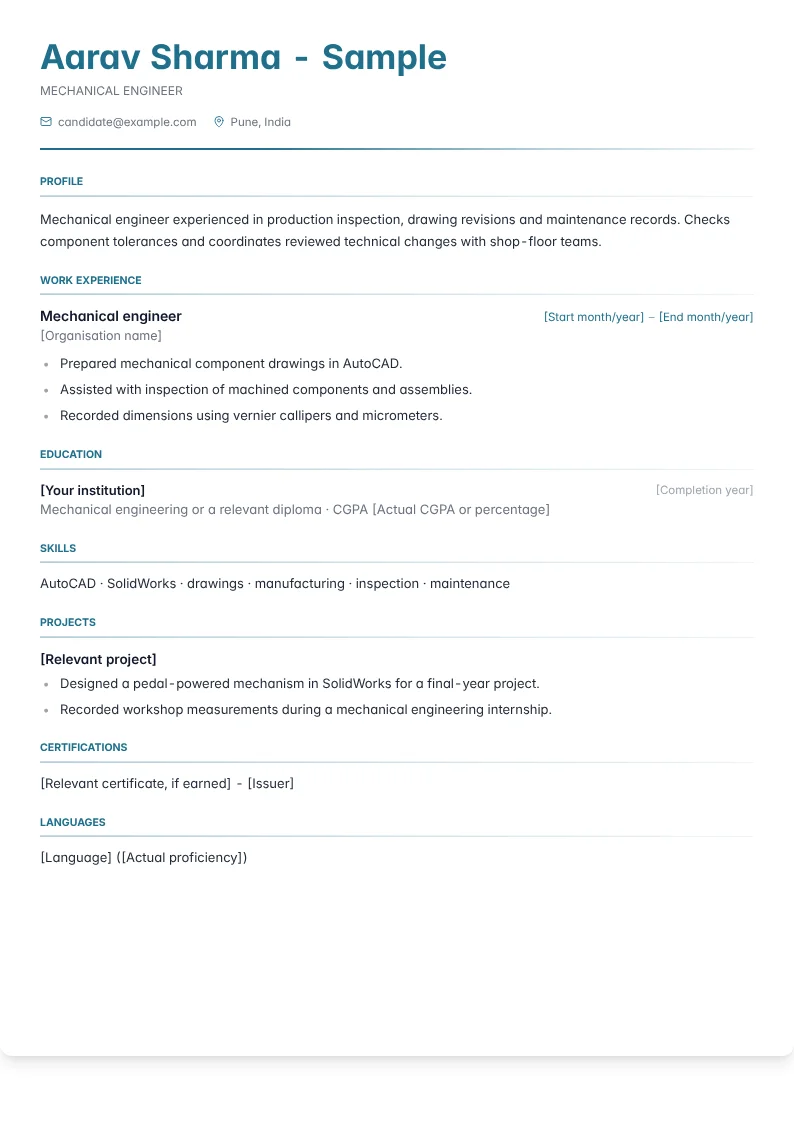
Aarav Sharma is fictional. Institution, organisation, grades and date fields are placeholders. Replace them with your real details. This is the Modern Clean layout.
Identify the engineering environment first
Mechanical engineering covers distinct kinds of work, so begin by locating your experience in design, manufacturing, maintenance, quality, thermal systems, or another relevant area. A recruiter in India may need to establish product familiarity, plant exposure, drawing competence, software use, and suitability for the advertised site arrangement. Do not let a generic objective obscure these essentials. Explain the physical system you worked on and the engineering responsibility you held. Designing a component, checking a drawing, supervising fabrication, and maintaining equipment are different contributions. A focused opening helps the reader assess fit without assuming that a mechanical degree automatically provides practical experience in every branch of the discipline or every stage of a product's lifecycle.
Connect calculations and drawings to physical constraints
Describe engineering work through loads, interfaces, materials, manufacturing processes, service conditions, or inspection needs as appropriate. CAD proficiency becomes meaningful when you explain what the model communicated and how it supported a decision. If you performed analysis, identify the assumptions, boundary conditions, and checks used to judge whether its results were plausible. Avoid treating a simulation image as proof that a design was validated. For manufacturing work, explain the relationship between drawing intent and the process available on the shop floor. For maintenance, describe symptoms, diagnosis, and the basis for corrective action. Technical reviewers should see a chain of reasoning connecting the physical problem to your recommendation, not merely evidence that you operated a software package.
Build a portfolio that respects engineering evidence
A useful mechanical portfolio can include original drawings, assembly views, calculation notes, or an authorised project summary. Explain units, assumptions, revision status, and your contribution. Freshers should distinguish academic exercises from fabricated and tested work, making clear whether a prototype was actually built. Internships can demonstrate observation and supervised participation without implying independent approval authority. Experienced applicants should emphasise design changes, production support, failure investigation, or coordination with suppliers and manufacturing teams. Remove proprietary dimensions and restricted customer information from shared material. Software courses and professional credentials can provide optional supporting evidence; furnish a particular certificate if the vacancy asks for it. A reviewer should never need to guess whether a displayed result is conceptual, simulated, inspected, or physically verified.
Turn a CAD duty into an engineering contribution
This hypothetical rewrite demonstrates how to describe design work without inventing weight, cost, or performance gains. • Before: Prepared CAD models and drawings for machine components. • After: Revised a mounting bracket model to accommodate the mating assembly, updated hole callouts and datum references, and incorporated fabrication feedback into the released drawing package. The revised bullet identifies interfaces, documentation, and collaboration. Use released only if the drawing genuinely passed the applicable internal process; otherwise say submitted for review. Be prepared to explain the fit concern, why the references mattered, and who approved the change. If your role was drafting from an engineer's marked drawing, state that boundary clearly rather than implying that you selected the design independently.
Avoid four errors that obscure practical competence
First, listing CAD and analysis tools without any associated engineering task makes proficiency difficult to judge. Second, reporting simulation results without assumptions or validation gives a false sense of certainty. Third, confusing participation in a team project with authority to approve its design overstates responsibility. Fourth, sharing detailed employer drawings can breach confidentiality even when the title block is removed. Address these issues through selected examples, explicit analysis limits, accurate contribution language, and genuinely safe portfolio material. Check technical terminology carefully, including units and the distinction between tolerances, dimensions, and measured variation. If you cannot support an asserted improvement with records, describe the verified design change instead. Engineering credibility depends on traceability, not on making every bullet sound transformative.
Prepare for Indian industry screening
Tailor your application to the actual sector and function rather than using one mechanical profile for every vacancy. An equipment maintenance role may value fault diagnosis and service coordination, while a design position may examine drawings, interfaces, and calculations. Indian recruiters may also clarify plant location, travel, shift arrangements, and joining availability; answer according to the advertised role and your genuine constraints. Freshers should prepare to discuss a project from first principles and explain what they personally calculated, modelled, or observed. Experienced engineers should select an example where practical constraints changed the initial plan. During interviews, be comfortable acknowledging when specialist review or additional measurement was needed. That judgement is part of responsible engineering, not an admission that the contribution lacked value.
Arrange the evidence for this application
Use a profile naming your design, production or maintenance direction, then list the matching work or project packages. Put CAD evidence beside the component it describes. Fresh graduates should lead with education and a technical project; established engineers can move education below industrial assignments. Keep workshops and software courses subordinate to drawings, checks and actual responsibilities.
Key skills and tools
- AutoCAD
- SolidWorks
- drawings
- manufacturing
- inspection
- maintenance
Copy only statements that match your actual work. Replace bracketed metrics only with verified values, or remove the number. These suggested revisions are examples, not claims about a real candidate.
Fresher and project bullet examples
Designed a pedal-powered mechanism in SolidWorks for a final-year project.
Recorded workshop measurements during a mechanical engineering internship.
Tested tensile specimens and documented results in a college materials lab.
Prepared a bill of materials for a student fabrication project.
Observed pump maintenance and updated inspection notes under a plant mentor.
Built an AutoCAD drawing portfolio from academic machine design assignments.
Experienced bullet examples
Prepared mechanical component drawings in AutoCAD.
Assisted with inspection of machined components and assemblies.
Recorded dimensions using vernier callipers and micrometers.
Reviewed preventive maintenance logs for recurring equipment issues.
Supported production checks under engineering supervision.
Documented drawing revisions and engineering review comments.
Reduced measured machining cycle time by [X]% through approved process changes.
Checked component tolerances against drawing specifications.
Inspected [N] components and logged non-conformities.
Coordinated technical clarifications with production teams.
Created SolidWorks assembly models for reviewed design changes.
Maintained equipment service checklists and breakdown records.
Three summary examples
Mechanical engineering fresher with AutoCAD, SolidWorks and fabrication projects. Practised component measurement and documented laboratory and workshop results.
Mechanical engineer experienced in production inspection, drawing revisions and maintenance records. Checks component tolerances and coordinates reviewed technical changes with shop-floor teams.
Mechanical candidate with plant internship exposure and prior work in another technical function. Applies workshop observation and CAD training to component checks and maintenance documentation.
Frequently asked questions
Should I include every CAD package I have tried?
Prioritise packages you can use for relevant tasks and explain through examples. Label training exposure separately from professional application.
Can a final year project be my main evidence?
Yes, especially as a fresher. Describe the problem, your contribution, assumptions, and whether the design was built or tested.
How do I discuss confidential drawings?
Use an independent example or an authorised, genuinely sanitised summary. Removing a company name alone may not make a drawing safe to share.
Are analysis results enough to claim validation?
Not automatically. Explain the checks performed and distinguish numerical analysis from physical testing, inspection, or formal acceptance.