
Resume Ground resources
Electrical engineer resume example
A practical Indian electrical engineer resume format, with sample statements for freshers and experienced applicants.
The button opens the existing template and role-starter flow. Where no matching starter exists, start blank and copy suitable statements below.
Sample resume, not a real candidate
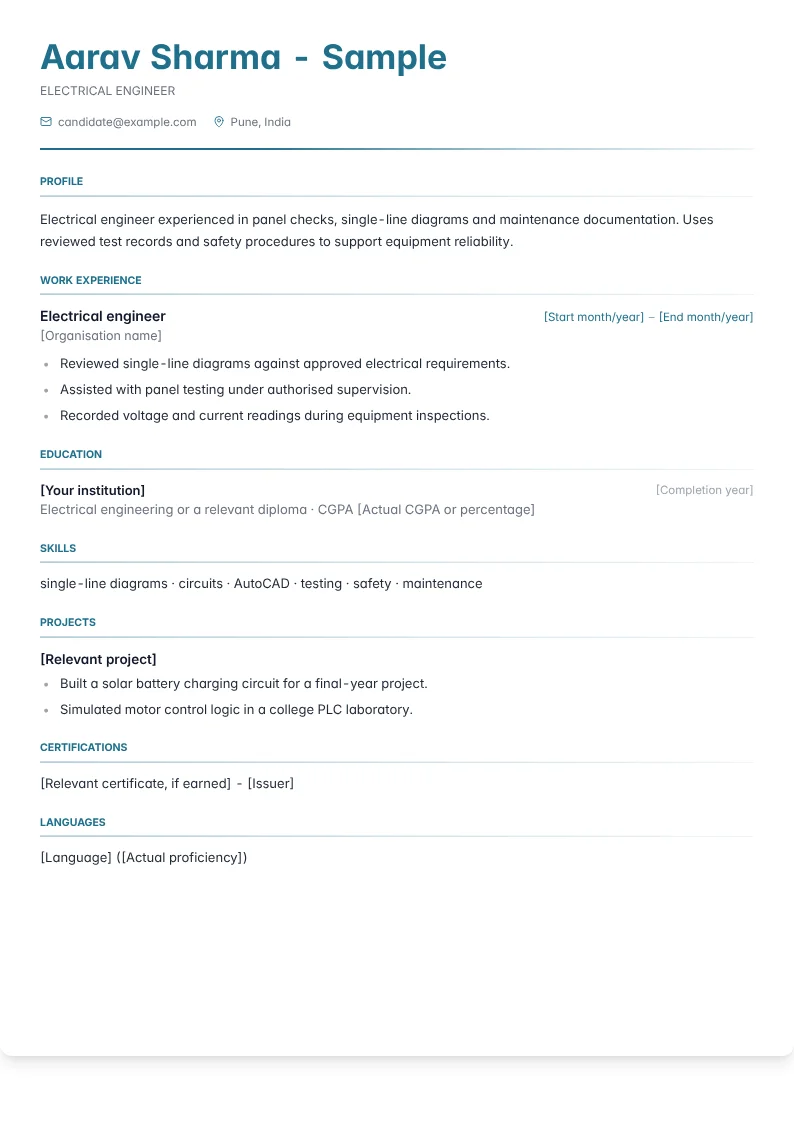
Aarav Sharma is fictional. Institution, organisation, grades and date fields are placeholders. Replace them with your real details. This is the Modern Clean layout.
Clarify the systems and responsibility involved
An electrical engineer application should identify the systems you know before presenting a broad technical inventory. Building services, industrial power, equipment maintenance, controls, testing, and product development involve different work. Recruiters in India may screen for the relevant environment, drawing knowledge, equipment familiarity, site exposure, and software alignment. Make it clear whether you designed, reviewed, installed, tested, maintained, or observed a system. These verbs imply different levels of responsibility. Avoid describing supervised exposure as independent commissioning authority. A focused opening should help a reviewer understand the scale and context qualitatively without unsupported ratings or project claims. It should also show where your practical experience ends and where you worked under a senior engineer's direction.
Describe technical judgement and safe boundaries
Choose examples that connect calculations, drawings, equipment behaviour, and site conditions. Depending on your work, useful evidence may include interpreting a single line diagram, checking a load schedule, reviewing cable information, investigating a protective trip, or documenting test observations. Explain the inputs and assumptions behind any selection or calculation. Do not imply that operating equipment proved a design was fully acceptable. When discussing field work, identify the supervision, isolation arrangements, and approval boundaries that genuinely applied without inventing a universal procedure. Technical reviewers need to understand how you recognised uncertainty and escalated concerns. Responsible engineering language describes what was checked, by whom, and against which project information, rather than making an unsupported claim that the installation was safe.
Remove four credibility and safety problems
Four mistakes are particularly damaging in this field. Claiming independent energisation or approval when you only assisted misstates authority. Listing equipment names without explaining your task offers little evidence of competence. Quoting design conclusions without the relevant assumptions makes calculations difficult to assess. Sharing site drawings, panel photographs, or customer information without permission can expose sensitive details. Replace these weaknesses with precise responsibility language, task based examples, documented reasoning, and authorised material. Avoid turning the resume into operating instructions for hazardous work. You can demonstrate judgement by describing the issue identified and the review sought. Where a credential or permission may depend on the vacancy and work location, do not assume a universal requirement or claim entitlement you have not established.
Rewrite a site activity as a precise contribution
Consider this hypothetical revision for a candidate who supported testing documentation. • Before: Handled electrical installation and commissioning activities at site. • After: Assisted the commissioning engineer by checking panel labels against approved drawings, recording test observations, and tracking discrepancies for review before the planned energisation. This wording explains the work without claiming independent authorisation or an unmeasured reliability improvement. Use assisted only when it accurately reflects your role, and do not imply that every listed activity belonged to the same assignment unless it did. In conversation, clarify who performed the tests, who reviewed the records, and how discrepancies were closed. Experienced applicants with genuine approval responsibilities can describe those explicitly, provided their authority and the project context are accurately represented.
Choose evidence for freshers and experienced engineers
Freshers can use an academic design exercise, supervised laboratory work, or an internship report to demonstrate drawing interpretation, calculation discipline, and careful observation. Clearly label simulations and avoid implying that a laboratory setup represents a live industrial installation. Experienced engineers should emphasise troubleshooting, design coordination, maintenance planning, contractor interfaces, or review responsibilities relevant to the vacancy. A portfolio might contain an original schematic, a sanitised calculation example, or an authorised technical summary. Explain what you contributed and which checks remained with another person. Degrees, training, and professional credentials are supporting evidence; provide documentation if the vacancy asks for it. Where eligibility for a particular responsibility is uncertain, seek clarification from the employer instead of presenting a course certificate as automatic authorisation.
Prepare for sector specific screening in India
Match your application to the sector rather than relying on the electrical engineer title alone. A facilities role may emphasise maintenance records and fault response, while a design office may focus on calculations, drawings, and coordination. Indian recruiter discussions can also cover site location, travel, shifts, and joining availability; confirm the actual arrangement rather than assuming it. Prepare to explain a diagram, a calculation, and a technical problem from your own experience. Freshers should distinguish what they observed from what they performed. Experienced candidates should describe how they handled conflicting information, incomplete records, or a condition requiring escalation. Sound answers acknowledge review boundaries and evidence gaps while showing how you helped move the work towards a defensible technical decision.
Arrange the evidence for this application
Place the electrical discipline and equipment context before recent assignments. Group diagram, testing and maintenance evidence by project rather than by software. For a first job, education can precede a documented circuit or power-system exercise. Keep supervised placement work distinct, and put any vacancy-requested credential where it can be checked without obscuring your actual scope.
Key skills and tools
- single-line diagrams
- circuits
- AutoCAD
- testing
- safety
- maintenance
Copy only statements that match your actual work. Replace bracketed metrics only with verified values, or remove the number. These suggested revisions are examples, not claims about a real candidate.
Fresher and project bullet examples
Built a solar battery charging circuit for a final-year project.
Simulated motor control logic in a college PLC laboratory.
Recorded insulation resistance readings during a supervised electrical internship.
Prepared a load calculation sheet for an academic building design project.
Observed transformer maintenance and documented safety steps under a plant mentor.
Tested a low-voltage circuit prototype and compared readings with calculations.
Experienced bullet examples
Reviewed single-line diagrams against approved electrical requirements.
Assisted with panel testing under authorised supervision.
Recorded voltage and current readings during equipment inspections.
Maintained preventive maintenance checklists for electrical assets.
Checked cable and component specifications against project schedules.
Prepared electrical test summaries for engineering review.
Reduced fault investigation time by [X]% through documented diagnostic checks.
Followed lockout and electrical safety procedures during assigned tasks.
Reviewed [N] test records for incomplete readings.
Coordinated technical queries with the supervising electrical engineer.
Updated AutoCAD electrical drawings after approved design revisions.
Logged motor inspection findings and corrective action status.
Three summary examples
Electrical engineering fresher with circuit projects, load calculations and laboratory testing. Practised safe measurement and documented supervised electrical observations.
Electrical engineer experienced in panel checks, single-line diagrams and maintenance documentation. Uses reviewed test records and safety procedures to support equipment reliability.
Electrical candidate with plant internship work and prior experience in another technical field. Applies electrical coursework and supervised diagnostics to drawing reviews and equipment checks.
Frequently asked questions
Should I mention site work if I only observed it?
Yes, if relevant, but label it as observation or supervised exposure. Explain what you learned without implying that you performed or authorised the work.
Can I include electrical drawings in a portfolio?
Use original educational examples or material you are authorised to share. Check for sensitive system details even after names and title blocks are removed.
Does a training certificate establish approval authority?
Do not assume so. Describe the training accurately and clarify any role specific eligibility with the employer if the vacancy asks for it.
How should I present troubleshooting experience?
Describe the symptom, evidence reviewed, your contribution, and the escalation or corrective process. Avoid unsafe procedural detail and unsupported claims of sole responsibility.