
Resume Ground resources
Civil engineer resume example
A practical Indian civil engineer resume format, with sample statements for freshers and experienced applicants.
The button opens the existing template and role-starter flow. Where no matching starter exists, start blank and copy suitable statements below.
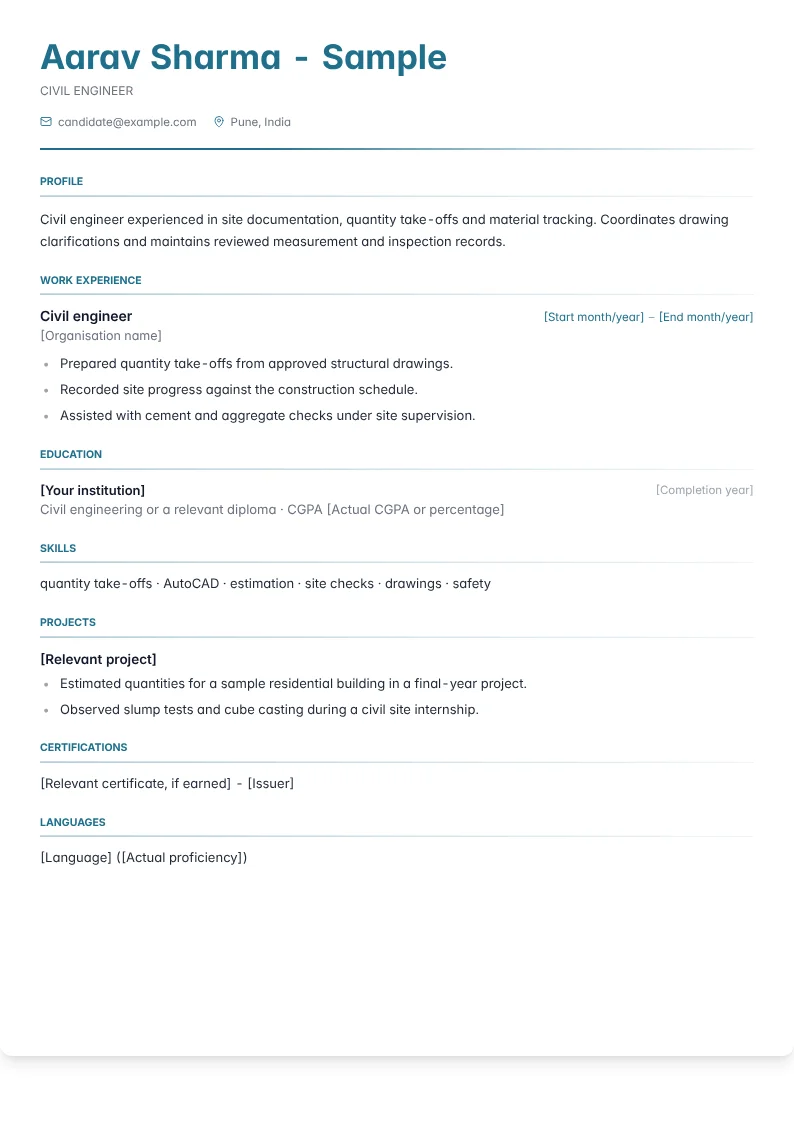
Sample resume, not a real candidate
Aarav Sharma is fictional. Institution, organisation, grades and date fields are placeholders. Replace them with your real details. This is the Modern Clean layout.
Anchor the resume in project context
Civil engineering recruiters need to understand what was being built and where your responsibility sat within the project team. Start with the relevant project type, such as residential construction, roads, industrial facilities, or water infrastructure. Distinguish site execution, planning, quantity work, design assistance, and quality documentation rather than treating them as interchangeable experience. For Indian applicants, contractor, consultant, developer, and client side settings can involve different responsibilities even when job titles look similar. Explain your actual position in that arrangement. A project description should provide enough context to interpret your work without disclosing confidential contract information. Name construction methods or materials only where you can explain their relevance from direct involvement or clearly labelled study.
Show how drawings became checked work
Strong experience statements connect a technical input to an observable site or office activity. Explain whether you interpreted drawings, checked quantities, maintained inspection records, prepared planning updates, or coordinated clarification of discrepancies. Recruiters may look for drawing literacy, measurement discipline, document control, and practical communication with site teams. Be precise about review boundaries: preparing a quantity sheet differs from approving a bill, and recording an inspection differs from certifying structural adequacy. If you used a code, specification, or test reference, identify only what you actually consulted and how it informed the task. Avoid presenting general awareness as authority to approve design changes or accept work outside your assigned responsibility on the project.
Rewrite site duties without inventing project results
Here is a hypothetical improvement: • Before: Supervised construction and ensured quality. • After: Checked reinforcement placement against issued drawings, recorded discrepancies, and coordinated clarification with the site engineer before the next activity. This makes the check and escalation visible without claiming design approval or an invented reduction in rework. Adapt the structure to a task you genuinely performed. A planning applicant might instead explain how site updates informed a progress schedule, while a quantity applicant could describe how measurement records supported a draft bill. Do not combine responsibilities from several disciplines merely to appear versatile. A clear account of one defensible contribution is more useful than a broad statement that you managed everything.
Select technical evidence that can be reviewed
An optional portfolio can include a self created drawing exercise, a quantity takeoff from a publicly usable sample, a fictional inspection checklist, or a planning example with stated assumptions. Explain the input, your method, and what remains subject to review. Software screenshots alone rarely show whether you understand the engineering behind the output. Remove employer drawings, client details, tender prices, and restricted project documents unless you have explicit permission to share them. Academic qualifications and relevant training can support your application, while particular credentials should be supplied if the vacancy asks for it. Describe software capability by task, separating viewing and markup from modelling, analysis, detailing, or coordinated production work that you can actually demonstrate.
Distinguish graduate exposure from project ownership
A fresher should foreground internships, site visits with substantive learning, final year work, and technical exercises. Explain whether you observed a process, assisted with it, or completed a supervised task. An academic structural model should not be presented as an approved design for construction. Experienced applicants should give more attention to assigned work packages, coordination interfaces, technical records, and the way issues were escalated or resolved. Identify team leadership only where it was part of your role. If moving from site execution to planning or design, show relevant preparation and transferable evidence without claiming an established specialism. Your project list should help the reader understand progression, not simply accumulate impressive client names or construction terminology.
Remove overstatement and practical mismatches
Four mistakes often weaken civil engineering applications. One is claiming responsibility for an entire project when you supported a limited package. Another is listing design software without a defensible example of its use. A third is confusing quantity preparation with commercial approval or certification. The fourth is sharing proprietary drawings as proof of experience. Check each technical claim against what you could explain using a clean sample or a nonconfidential account. If the vacancy involves site travel, relocation, or a particular work environment, state your genuine preferences when requested. Keep safety related descriptions factual and tied to your assigned activities rather than claiming that your presence alone guaranteed safe execution across the construction site.
Arrange the evidence for this application
Identify site, quantity, planning or design exposure first, then list the project packages closest to the advertised work. Place drawing and measurement skills alongside those assignments. Graduates can start with education and a technical project before site visits. Keep billing preparation separate from approvals, and do not let a long project-name list replace your package-level responsibilities.
Key skills and tools
- quantity take-offs
- AutoCAD
- estimation
- site checks
- drawings
- safety
Copy only statements that match your actual work. Replace bracketed metrics only with verified values, or remove the number. These suggested revisions are examples, not claims about a real candidate.
Fresher and project bullet examples
Estimated quantities for a sample residential building in a final-year project.
Observed slump tests and cube casting during a civil site internship.
Prepared AutoCAD floor plans for a college building design assignment.
Recorded level readings under supervision during a surveying camp.
Built an Excel bill of quantities for an academic construction estimate.
Updated daily progress notes under a site mentor during an internship.
Experienced bullet examples
Prepared quantity take-offs from approved structural drawings.
Recorded site progress against the construction schedule.
Assisted with cement and aggregate checks under site supervision.
Reviewed AutoCAD drawings for missing dimensions and conflicting details.
Maintained site measurement books and inspection records.
Supported toolbox safety checks within assigned responsibilities.
Reduced material reconciliation time by [X]% through Excel tracking.
Coordinated site queries with the supervising engineer.
Reviewed [N] drawing items against site requirements.
Documented observations from supervised site inspections.
Prepared reinforcement quantity sheets from approved bar bending schedules.
Tracked concrete pour records and test sample references.
Three summary examples
Civil engineering fresher with AutoCAD, surveying and quantity estimation projects. Recorded supervised site observations and prepared academic construction schedules.
Civil engineer experienced in site documentation, quantity take-offs and material tracking. Coordinates drawing clarifications and maintains reviewed measurement and inspection records.
Civil candidate with site internship exposure and previous work in another technical area. Combines construction coursework with supervised field measurement and practical documentation.
Frequently asked questions
Should every project have a value or area figure?
No. Project type, construction stage, your package, and your responsibilities can provide sufficient context. Include figures only when accurate and permissible to disclose.
Can site visits count as experience?
They can appear as learning exposure, clearly labelled as visits. Do not present observation as employment or responsibility for execution.
How do I describe billing exposure?
Specify whether you measured work, prepared supporting sheets, checked quantities, or assisted with a draft bill. Do not imply approval authority you did not hold.
What should a software portfolio explain?
Show the task, inputs, assumptions, and your contribution. Explain checks and limitations rather than relying only on attractive output images.