
Resume Ground resources
Finance analyst resume example
A practical Indian finance analyst resume format, with sample statements for freshers and experienced applicants.
The button opens the existing template and role-starter flow. Where no matching starter exists, start blank and copy suitable statements below.
Sample resume, not a real candidate
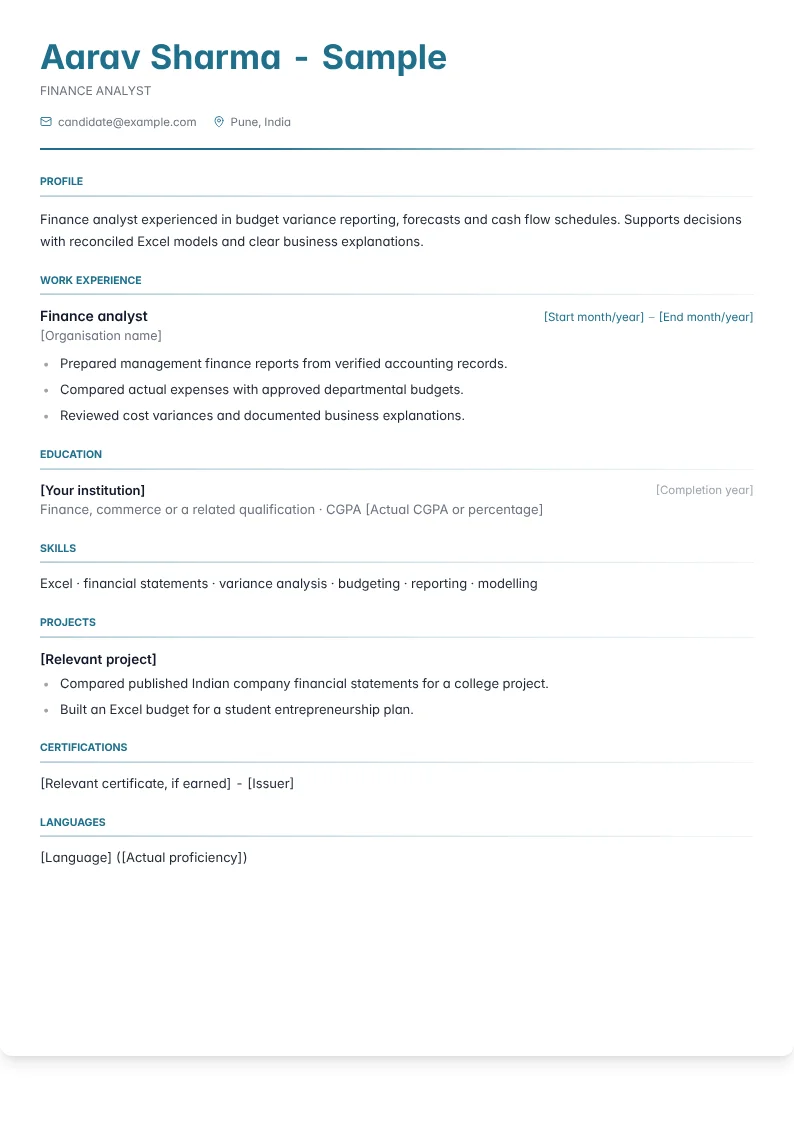
Aarav Sharma is fictional. Institution, organisation, grades and date fields are placeholders. Replace them with your real details. This is the Modern Clean layout.
Lead with the decisions your analysis supported
A finance analyst application is stronger when it starts with a business question rather than a catalogue of formulas. Explain whether your work supported budgeting, management reporting, profitability review, investment research, or another defined activity. Indian employers use this title for substantially different jobs, so the summary should establish the analytical setting immediately. Identify who used your work and what they needed to understand, such as a cost movement, revenue assumption, or cash requirement. Avoid implying that preparing a report meant making the final business decision. A recruiter should be able to distinguish your contribution from the responsibilities of the manager, business partner, or investment professional who reviewed and acted on it.
Show the route from source data to interpretation
Screening often turns on whether a candidate can explain how an output was built and checked. Describe the source systems, spreadsheet models, or query tools you genuinely used, then connect them to a specific analytical process. Reconciliation to an agreed source, consistent definitions, sensible assumptions, and investigation of unusual movements matter more than decorative charts. If you worked with Indian business units, explain relevant context such as branch reporting or product level comparisons without claiming expertise across every sector. Separate historical reporting from forecasting. Someone who refreshed a monthly dashboard should not describe that task as developing a predictive model unless they actually selected, tested, and maintained a forecasting approach with an appropriate review process.
Turn analytical work into a credible bullet
A hypothetical rewrite illustrates the difference between a deliverable and an analytical contribution: • Before: Made Excel reports for management. • After: Compared actual expenses with budget assumptions, traced unusual movements to supporting schedules, and summarised questions for the business review. The revised bullet explains what was compared, how the result was examined, and where it went next. It does not invent savings or claim that every recommendation was accepted. For your own experience, choose a genuine analytical episode and identify the uncertainty involved. Perhaps the source files used inconsistent categories, an assumption needed clarification, or a movement reflected timing rather than performance. Those details help an interviewer assess judgement instead of merely recognising familiar software names.
Build a model portfolio that can be questioned
Optional work samples can include a budget model using fictional inputs, a public company analysis based on cited disclosures, or a variance commentary prepared from synthetic data. Make assumptions visible and distinguish facts from estimates. Include a brief explanation of model limitations and how another person could update the workbook. Public information still needs attribution; a downloaded presentation is not your analysis simply because you redesigned its charts. Finance qualifications, relevant coursework, and completed professional examinations may support your application, but they should not substitute for demonstrable reasoning. State examination status accurately and provide particular credentials if the vacancy asks for it. Never share restricted forecasts, internal pricing, or unpublished employer performance information.
Pitch potential differently from established ownership
Freshers can use academic research, internships, case competitions, or independent models to show structured thinking. Identify whether the exercise involved real public information or invented assumptions, and explain your individual contribution to group work. An experienced analyst should give more space to recurring reporting cycles, stakeholder questions, model maintenance, and recommendations that were reviewed. Where your role changed from production to interpretation, make that progression visible. Applicants moving from accounting can highlight reconciliation discipline and explain their analytical exposure without relabelling routine posting as financial planning. Candidates from engineering or another quantitative background should connect technical methods to a financial question rather than assuming that a complex calculation automatically demonstrates commercial understanding.
Check for weak signals before applying
Four mistakes frequently undermine an analyst resume. One is presenting dashboard creation as analysis without explaining any interpretation. Another is claiming advanced modelling while being unable to explain assumptions or error checks. A third is reporting business improvements as personal achievements when several teams influenced the outcome and attribution is unclear. The fourth is mixing investment research, accounting operations, and planning terminology so loosely that the target role becomes uncertain. Read the vacancy for its actual work products and reorder your evidence accordingly. Keep technical skills proportionate to use: querying a prepared table differs from designing a data pipeline. Prepare to discuss one model limitation openly, because recognising uncertainty is part of sound financial analysis.
Arrange the evidence for this application
Set out the analytical setting first, then planning, reporting or research assignments and their decision-support outputs. Add a model or commentary link beside the corresponding project. A graduate can place education and a public-information financial study before unrelated employment. Keep investment research distinct from operating-budget work so the reader can see which vacancy you are addressing.
Key skills and tools
- Excel
- financial statements
- variance analysis
- budgeting
- reporting
- modelling
Copy only statements that match your actual work. Replace bracketed metrics only with verified values, or remove the number. These suggested revisions are examples, not claims about a real candidate.
Fresher and project bullet examples
Compared published Indian company financial statements for a college project.
Built an Excel budget for a student entrepreneurship plan.
Updated cost classification sheets during a finance internship.
Prepared a working capital case study using public annual reports.
Checked expense report totals under an internship supervisor's review.
Presented a ratio analysis of a listed company for a commerce assignment.
Experienced bullet examples
Prepared management finance reports from verified accounting records.
Compared actual expenses with approved departmental budgets.
Reviewed cost variances and documented business explanations.
Built Excel forecast models with clearly stated assumptions.
Validated model formulas against ledger and source schedules.
Supported rolling forecasts with inputs from business teams.
Reduced report preparation time by [X]% through reusable Excel worksheets.
Summarised budget movements for management review meetings.
Analysed [N] cost items against the agreed budget categories.
Maintained supporting schedules for monthly finance reviews.
Prepared cash flow projections from receivable and payable inputs.
Created Power BI views for expense trends and budget utilisation.
Three summary examples
Finance fresher with Excel modelling, ratio analysis and commerce projects. Prepared academic budgets and interpreted public financial statements with stated assumptions.
Finance analyst experienced in budget variance reporting, forecasts and cash flow schedules. Supports decisions with reconciled Excel models and clear business explanations.
Finance analysis candidate with internship expense reporting and prior experience in another business function. Connects operational context with budget analysis, working capital and verified financial data.
Frequently asked questions
Should I include a stock pitch for every finance analyst vacancy?
No. It fits investment research more naturally than expense planning or management reporting. Choose a sample that resembles the vacancy's actual analytical work.
Can accounting experience support an analyst application?
Yes. Reconciliation, financial statement familiarity, and disciplined checking are relevant foundations. Add genuine examples of interpretation or modelling rather than renaming accounting tasks.
Must every bullet show a financial improvement?
No. An accurate explanation of the question, method, checks, and decision support is preferable to an unsupported savings claim.
How should an unfinished finance qualification be listed?
Describe the stage actually completed and clearly identify ongoing study. Do not use a designation that implies you already hold the completed credential.